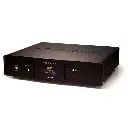
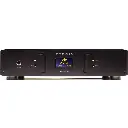

Rockna - Wavedream DAC
THE SOUND YOU EVER EXPECTED,
AND BEYOND
.
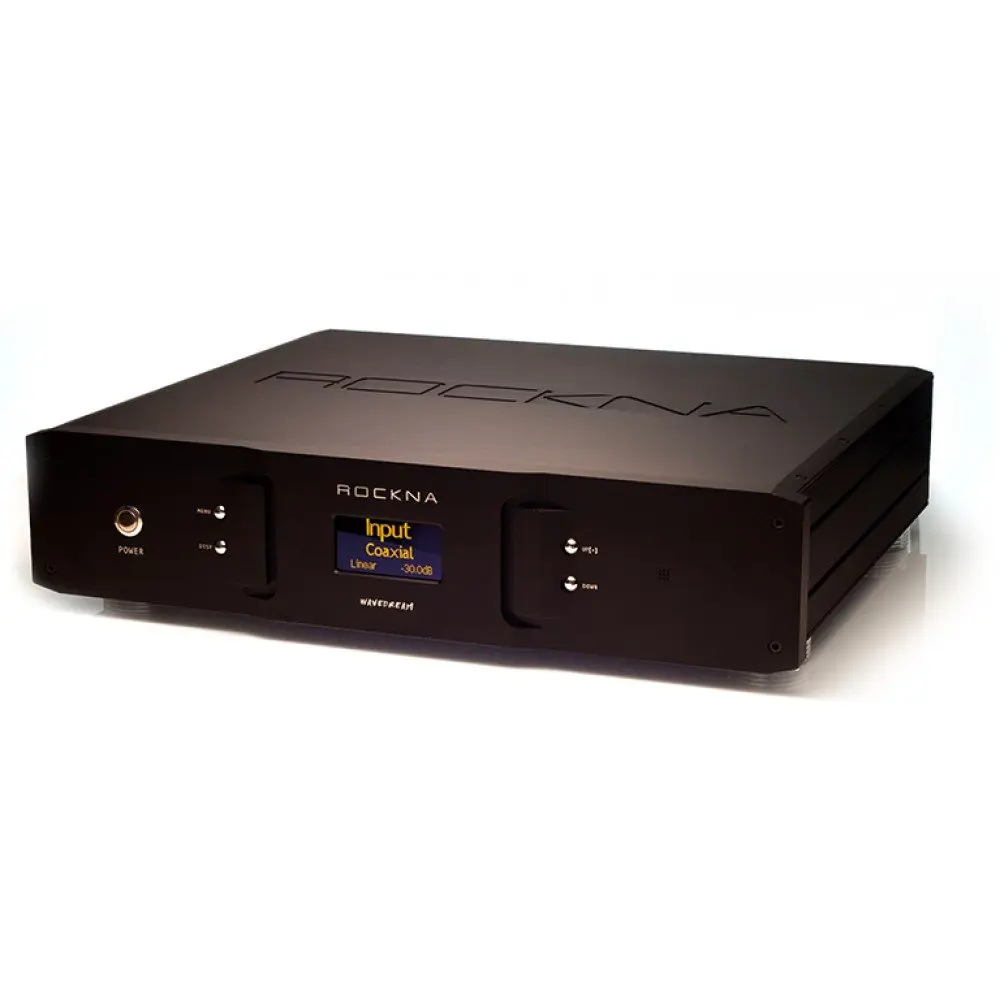
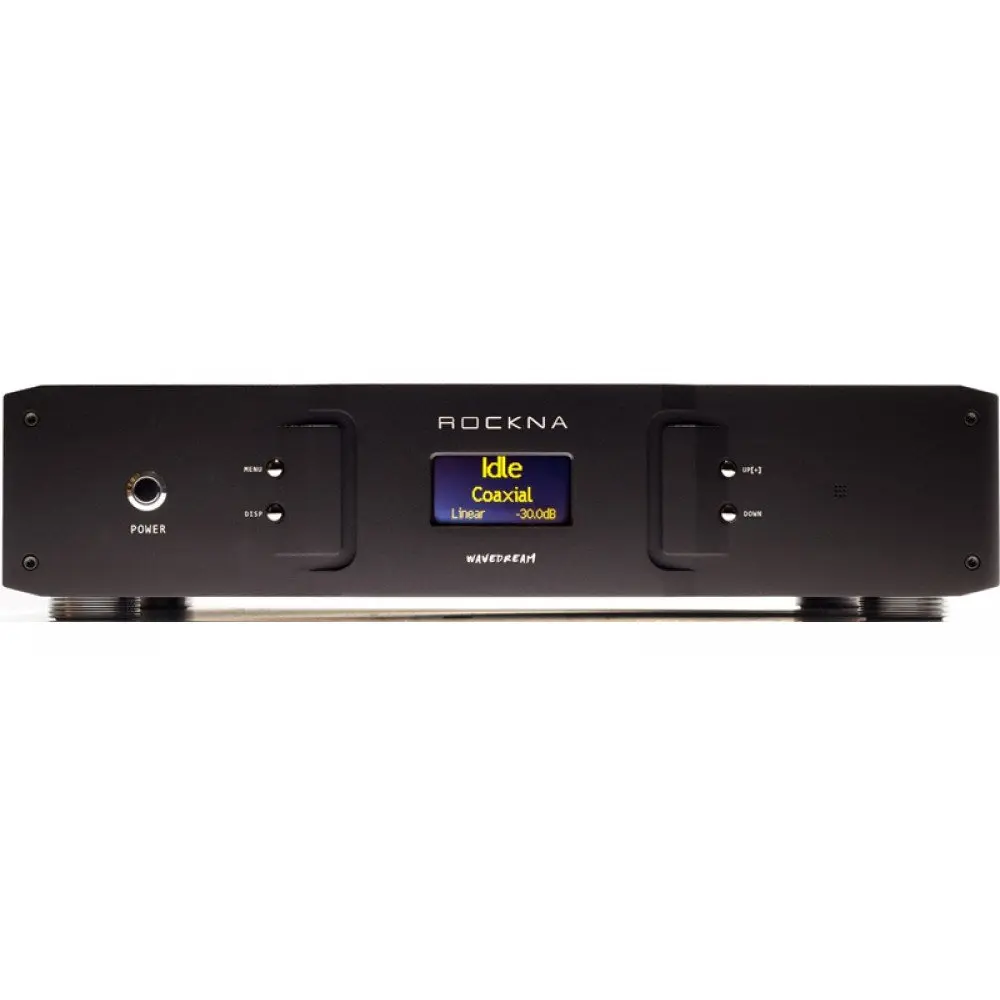
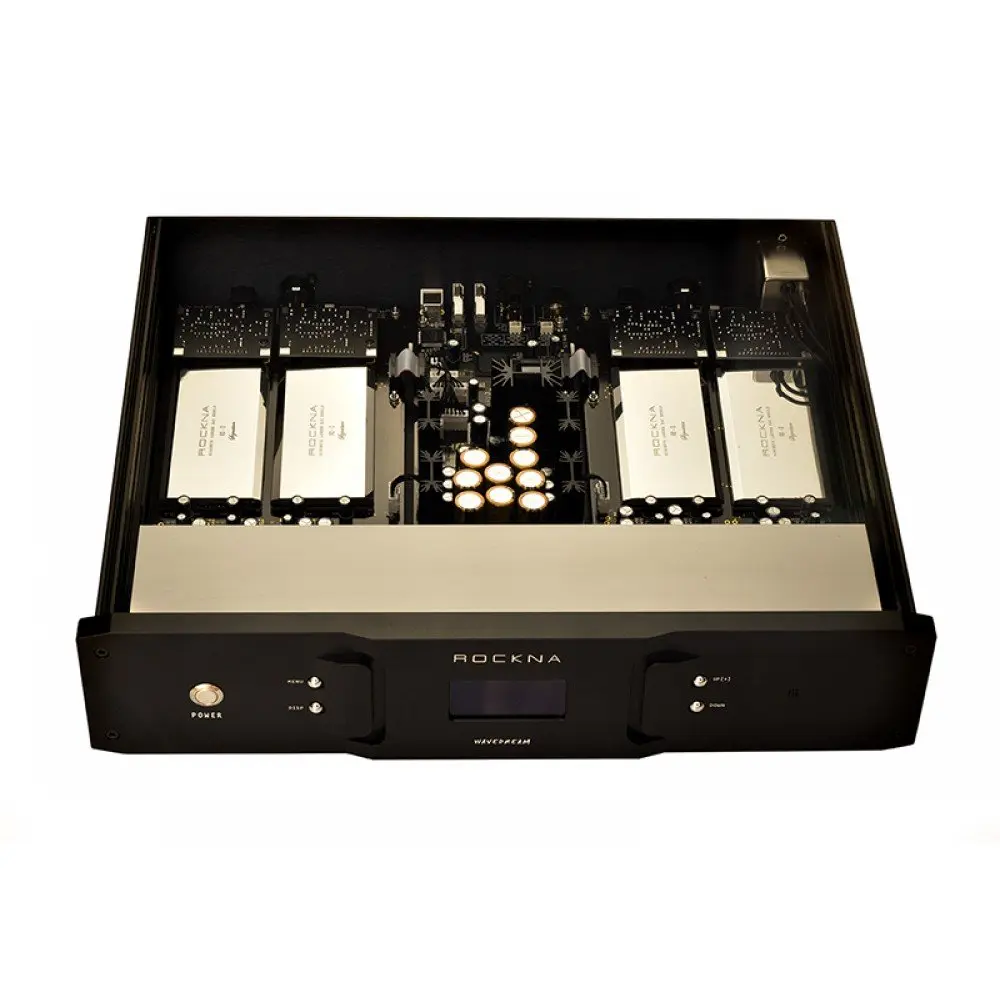
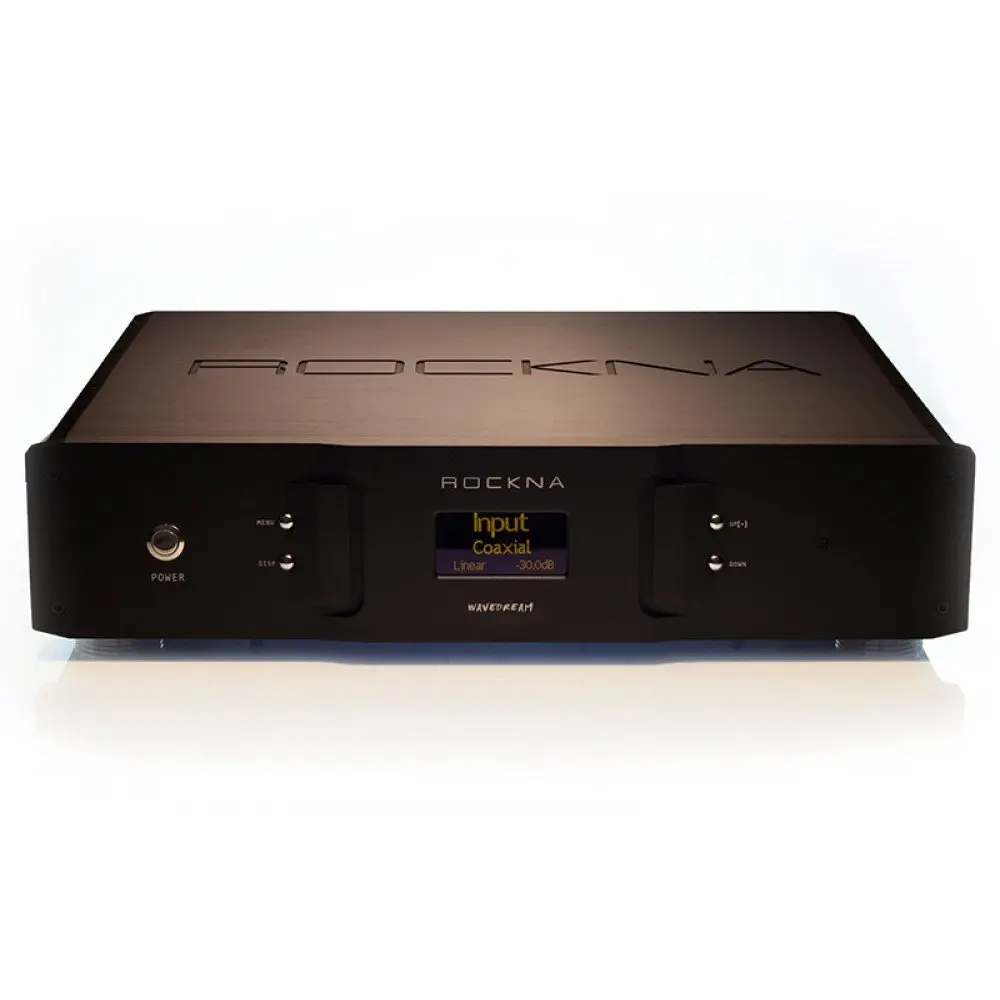
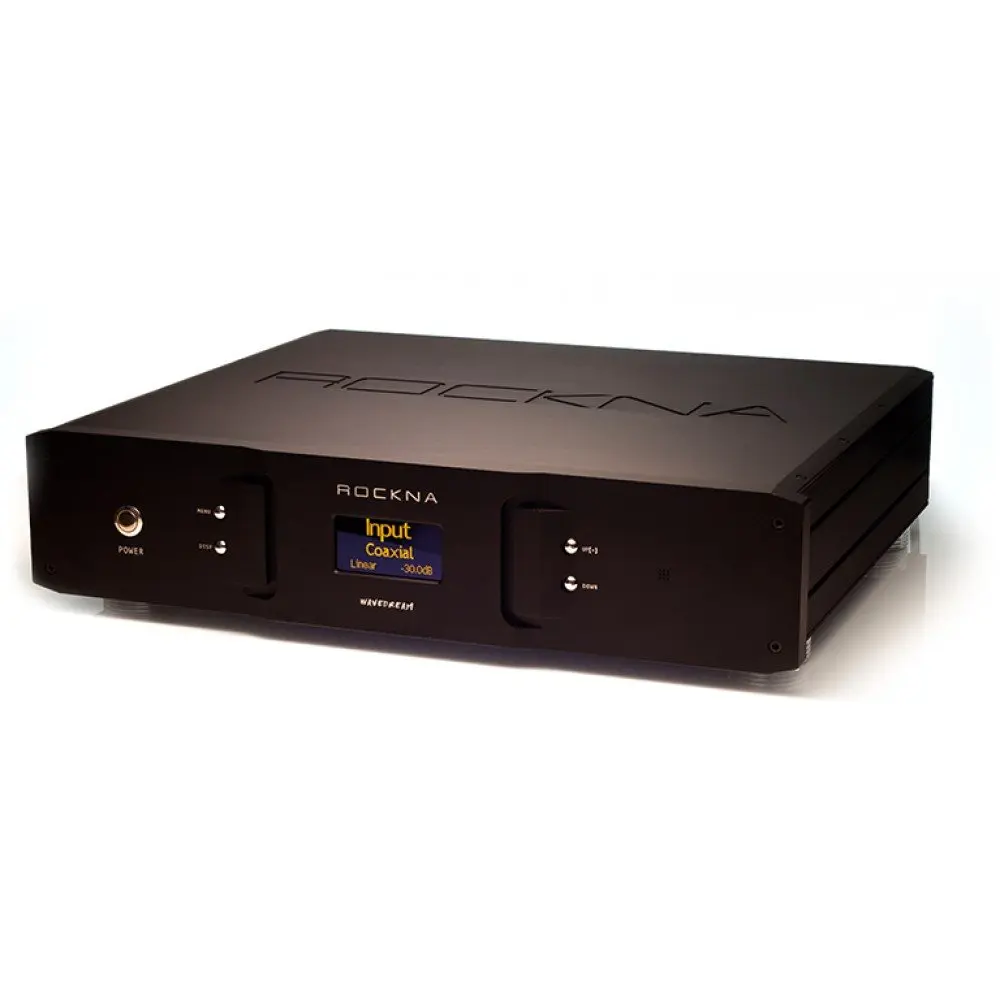
The Rockna Audio WAVEDREAM DAC is a flagship R2R converter built on a software-defined architecture powered by a custom FPGA. It incorporates an advanced femtovox clock system, proprietary digital filters, and a convenient display for intuitive operation. The RD-0 and RD-1 DAC modules deliver ultra-precise, noise-free conversion, while the fully discrete analog output stage ensures a highly natural presentation. Its robust power supply, featuring 20 linear regulators, supports exceptional stability, while the user-friendly menu provides control over preamp mode, phase, filters, clock, and dither settings. With a carefully designed chassis and internal layout to minimize interference, the WAVEDREAM stands out as one of the finest R2R DACs ever produced.
SOFTWARE & ARCHITECTURE
We always thought that high-end audio should be everything about innovation. Playing around with off-the-shelf available chips is fun and certainly a good and economic way to produce good sound. But once you want to design a cutting-edge product, the off-the-shelf approach doesn’t apply. Naturally, a custom solution, freed from the limitation of the available chipsets, come into place, allowing us to design and build from the scratch an entire digital audio system.
All building blocks of the Wavedream DAC concernig digital processing are built entirely on a single piece of programmable silicon – a FPGA . With a FPGA, it’s internal hardware architecture could be described by a piece of software (actually, a very complex one). When upgrading the Wavedream with new firmware, you actually change it’s hardware. This system allows great flexibility, obsolescence protection and let us improve the sound of your dac by changing it’s internal architecture, or add new cool features, or improve the existing ones.
ROCKNA Wavedream Review
Rockna Audio Wavedream Edition XLR – Full Review
6Moons Rockna Wavedream Review
" Its sound is detailed, hard-hitting, dynamic and exciting. It’s not the DAC to buy if you want a laid-back listen, or a warm and romantic sound signature. If you want something that is forward, and really commands your attention, the Wavedream is an excellent choice"
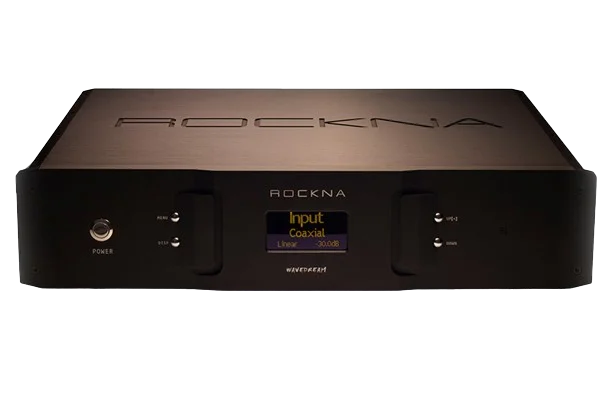
Wavedream DAC
SPECIFICATIONS
- AMD ZynQ SoC with custom Rockna firmware
- R2R discrete DAC modules RD-1 MK2 x 4
- 27-bit FPGA driven combined switches
- Optimized clock manager Femtovox 2
- Mirrored clock distribution
- Low-noise and fine-tuned power supply
- Local regulation on critical nodes
- Discrete regulation for analog stages
- Very large capacitor buffer
- Copper shielded audio grade transformers
- Critical paths with tight impedance control
- Hardware FPGA upsampling
- Proprietary Digital-PLL topology, ASRC-free
- Fully discrete output stage, standard version
- 32-bit ultrafine volume control
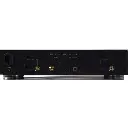
- LAN, USB, I2S, SPDIF, AES/EBU, Toslink inputs
- RCA and XLR outputs
- THD -100 dB (-3 dB); DNR 132 dB
- MAX. OUTPUT 2.3V RMS (RCA) 4.6V RMS (XLR)
- Full aluminum chassis, matt black or matt silver
- Dimensions: 450 x 390 x 105 mm, 10 kg
SIGNATURE VERSION
All above and:
- R2R discrete DAC modules RD-0 MK2 x 4
- 28-bit FPGA driven individual switch/bit
- Clock manager Femtovox 2-LPN version
- Ultralow-noise and fine-tuned power supply
- Fully discrete output stage, signature version
The clock is the heart of a digital reproduction system. It’s accuracy and jitter levels are critical in regard of sound quality. Only a very good clock system can make the way to the analog sound on the output of your DAC. If the clock is flawed, digital harshness will occur and the analog feeling of the music will be severely altered. Apart from the performance of the clock itself, equally critical is the construction of the clock tree (the clock distribution architecture) inside the DAC. The jitter amount that really counts it’s not only the performance of the clock itself – but the clock which actually enters the dac and is used for conversion – let’s call it the conversion clock. The conversion clock that enters the dac section relies on the clock tree, which is usually not just routing, but in most cases conditioning, altering it’s quality. A poorly designed clock tree can degrade significantly the clock quality entering the d/a section, even if the source clock has great performance.
With these facts in mind, we designed for the Wavedream an advanced clock system called the femtovox. With femtovox in place, one is assured that only extremely small amounts of jitter are present at the dac conversion clock input. It’s unique architecture employs that conversion clock is directly synthesised at the dac input, without any conditioning, giving constant jitter performance at any sample rate. The conversion clock is controlled with 1 ppb precision, while exhibiting about 300 fS of jitter. The smallest jitter figure in the world? No. The smallest jitter figure where actually matters? Probably.
The Wavedream upsamples any material with a fixed rate of 16x. The dac modules will decode the digital stream with a rate of 768Khz, or 705.6Khz, respectively, according to input sample rate. We found this rate to be optimal for analog performance of the dac modules. Behind this simple multiplication factor (16x) lies a huge processing power. The digital filters are made with the combined effort of 58 DSP blocks, resulting into a impressive figure of 15 GMACS of processing power.
The developed filters are unique. We avoided standard Nyquist rate filters as not providing the expected performance for the dac. After lots of mathematical simulations and careful listening tests, we have created a custom Parks-McClellan upsampling filter. There are three variations avaialble on current firmware: linear, minimumand hybrid phase. They are highly optimized filters, offering stunning performance with a large number of taps (5k), and they are different in regard of impulse response. For the linear phase, the ringing energy (Gibb’s overshoot) is equally split before and after impulse. Minimum phase type shows all this energy after impulse, while our special hyrid phase filter has a combined response between linear and minimum, exhibing very low overshoot before the impulse.
For the effective D/A conversion stage we developed dedicated dac modules called RD-0 (used in Signature – 27 bit structure) and RD-1 (used in Edition – 26 bit structure). Modules themselves are complex pieces of technology, sharing a discrete sign-magnitude hybrid ladder topology, driven by a complex algorythm which is embedded into their own FPGA. Therefore the dac modules firmware is updatable both performance and feature-wise. Currently RD-0/1 can sustain a maximum sample rate of 6 MHz, which is the industry’s maximum sample rate specified for a audio dac. The output of the dac modules is un-buffered, allowing maximum transparency and natural sound reproduction.
The clock is the heart of a digital reproduction system. It’s accuracy and jitter levels are critical in regard of sound quality. Only a very good clock system can make the way to the analog sound on the output of your DAC. If the clock is flawed, digital harshness will occur and the analog feeling of the music will be severely altered. Apart from the performance of the clock itself, equally critical is the construction of the clock tree (the clock distribution architecture) inside the DAC. The jitter amount that really counts it’s not only the performance of the clock itself – but the clock which actually enters the dac and is used for conversion – let’s call it the conversion clock. The conversion clock that enters the dac section relies on the clock tree, which is usually not just routing, but in most cases conditioning, altering it’s quality. A poorly designed clock tree can degrade significantly the clock quality entering the d/a section, even if the source clock has great performance.
With these facts in mind, we designed for the Wavedream an advanced clock system called the femtovox. With femtovox in place, one is assured that only extremely small amounts of jitter are present at the dac conversion clock input. It’s unique architecture employs that conversion clock is directly synthesised at the dac input, without any conditioning, giving constant jitter performance at any sample rate. The conversion clock is controlled with 1 ppb precision, while exhibiting about 300 fS of jitter. The smallest jitter figure in the world? No. The smallest jitter figure where actually matters? Probably.
Finally, the last stage of the signal path is the analog output stage. It’s contribution to final sound is of extreme importance. Designed from the scratch to work with converter modules RD-0 & RD-1, the output stage is totally discrete and acts as a high-speed buffer. Made entirely with through-hole components (non-smd), we combined j-fet & bipolar devices into a class A design, with a closed-loop output impedance of under 1 ohm and equivalent input noise as low as 1nV, as a perfect match for the converter overall performance.
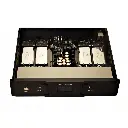
Naturally we have dedicated sections for digital and analog areas. There are 3 separate transformers, and all power supplies are low noise linear - no switchmode power supplies are used whatsoever. There are a total of 20 linear regulators inside the dac. We dedicated our attention to the dac modules regulators – which are designed from the scratch for low impedance and ultra-low noise.
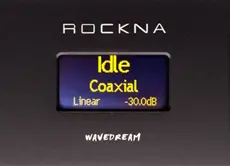
EXTRA MENU FEATURES
On the dac menu can be found a series of useful features. Let’s take a short walkthrough.
- The preamp feature - The Wavedream has a 256 steps volume control which allows direct connection of a power amplifier. The volume control has 0.5 dB steps for a fine resolution setting.
- The phase select feature – the user can change the absolute phase of the output signal.
- The filter select feature – discussed above. The filters can be switched off for NOS operation.
- The clock setting – there are 2 modes of the digital PLL response, stream and local. Please reffer to the clock technical document under the technology section for more information.
- Dither – to improve R2R ladder linearity, ultrasonic dither is applied on the last 4 bits from the digital 24-bit word.
WAVEDREAM REFERENZ (SIGNATUR) SPEZIFIKATIONEN
DIGITAL INPUTS| S/PDIF | 24bit 44.1-192k PCM , DoP DSD64 |
| AES/EBU | 24bit 44.1-192k PCM, DoP DSD64 |
| USB | 32bit 44.1-384k PCM, DSD64-512 |
| HD-Link1 (LVDS) | 32bit 44.1-384k PCM, DSD64-512 |
| HD-Link2 (LVDS) | 32bit 44.1-384k PCM, DSD64-512 |
| THD+N (at - 6dB): | 0.003% or -90 dB |
| S/N ratio (0 dB): | 122 dB |
| Dynamic range: | 122 dB |
| Output impedance: | 0.5 ohms |
| Max. voltage: | 6.6Vpp(SE); 13.2Vpp(XLR) |
| THD+N (at -6db): | 0.0008% or -102 dB |
| S/N ratio (0 dB): | 132 dB |
| Dynamic range: | 132 dB |
| Output impedance: | 0.5 ohms |
| Max. voltage: | 10Vpp(SE); 20Vpp(XLR) |
| High-frequency asynchronous capture digital inputs: | 560MHz sampling |
| Memory-based PLL, digital domain only: | 300 fS jitter |
| Custom digital filters: | linear, minimum and hybrid phase, 16x |
| Filter type: (advanced convolution) | Parks-McClellan, 4820 taps |
| Mathematical precision: | 68 bit INTEGER |
| Stopband attenuation: | - 145 dB |
| Passband ripple: | 0,0001 dB |
| Dither: | Triangular shaped distribution |
| Volume control: | custom multiplier array, 256 steps, 0.5 dB step |
| 128x64 yellow oled display, dimmable in 8 steps |
| 4 control switches |
| IR remote control |
| Firmware upgrade via usb |
| Dimensions: 440 x 360 x 90 mm |
| Weight (net): 7.8 Kg |
Über ROCKNA AUDIO
ROCKNA AUDIO wurde 1999 gegründet, um eine tiefgründige, angenehme und inspirierende Musikwiedergabe zu suchen. Seitdem hat sich in unserem Unternehmen eine bemerkenswerte Entwicklung vollzogen, die nicht aufhören wird. Unser gesamtes Team wird von der gemeinsamen Leidenschaft für Technologie angetrieben. Eine Leidenschaft, die uns niemals erlauben wird, „Me-Too“-Produkte herzustellen. Wir möchten eine Option anbieten – eine andere – um zu zeigen, dass Dinge anders gemacht werden können.

Our latest content
Check out what's new in our company !