




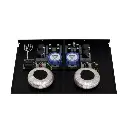
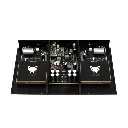
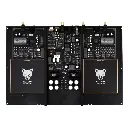
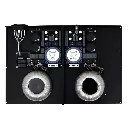



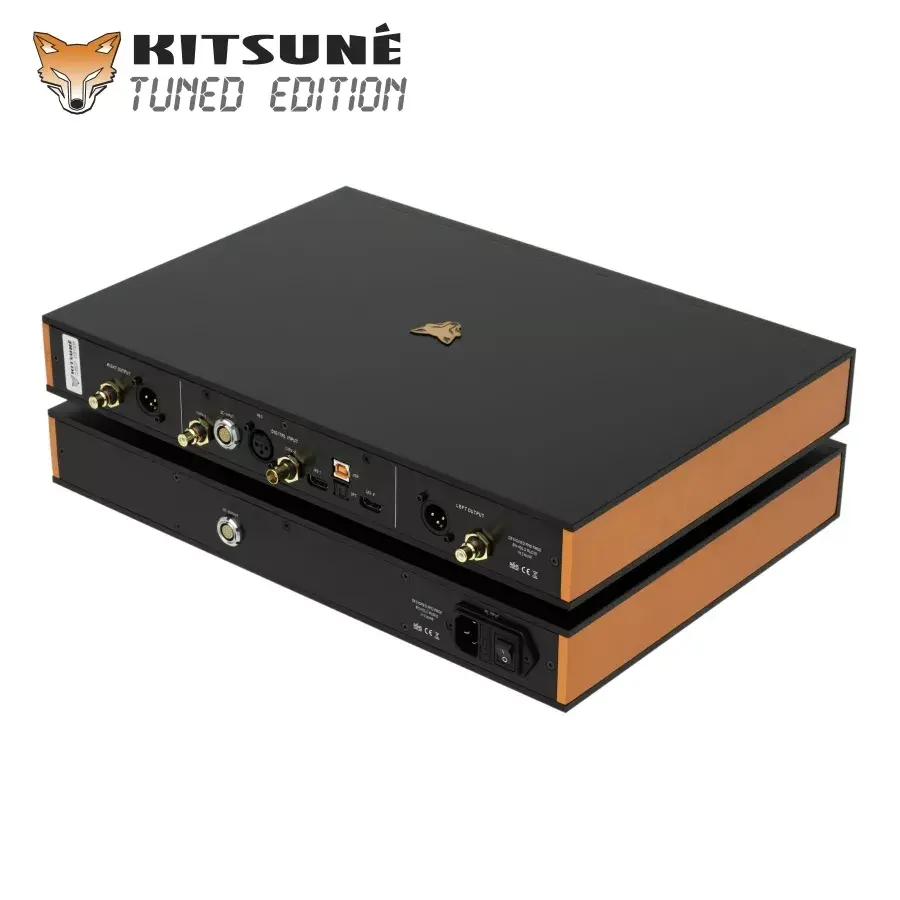
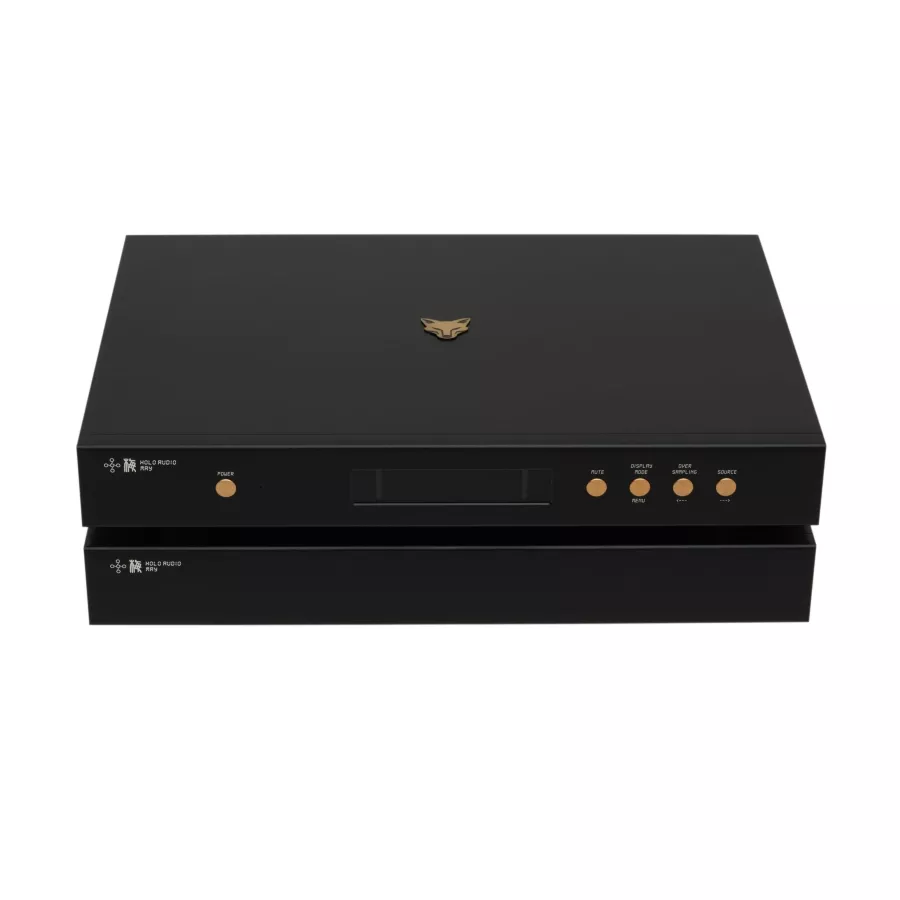
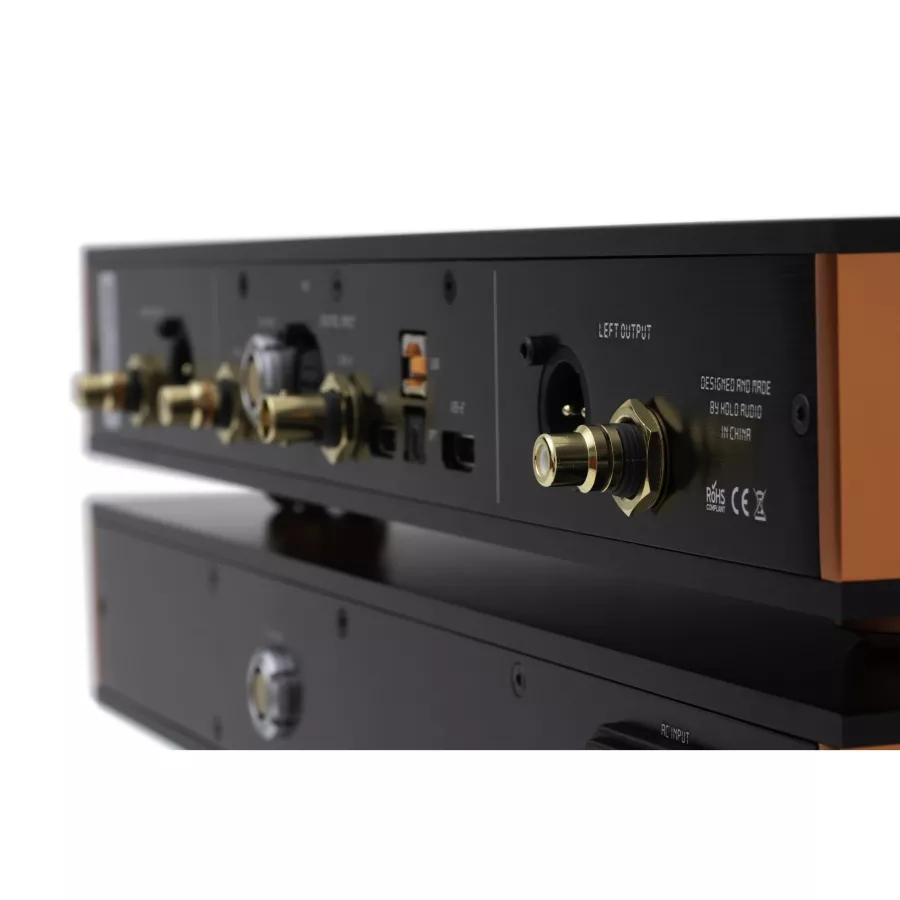
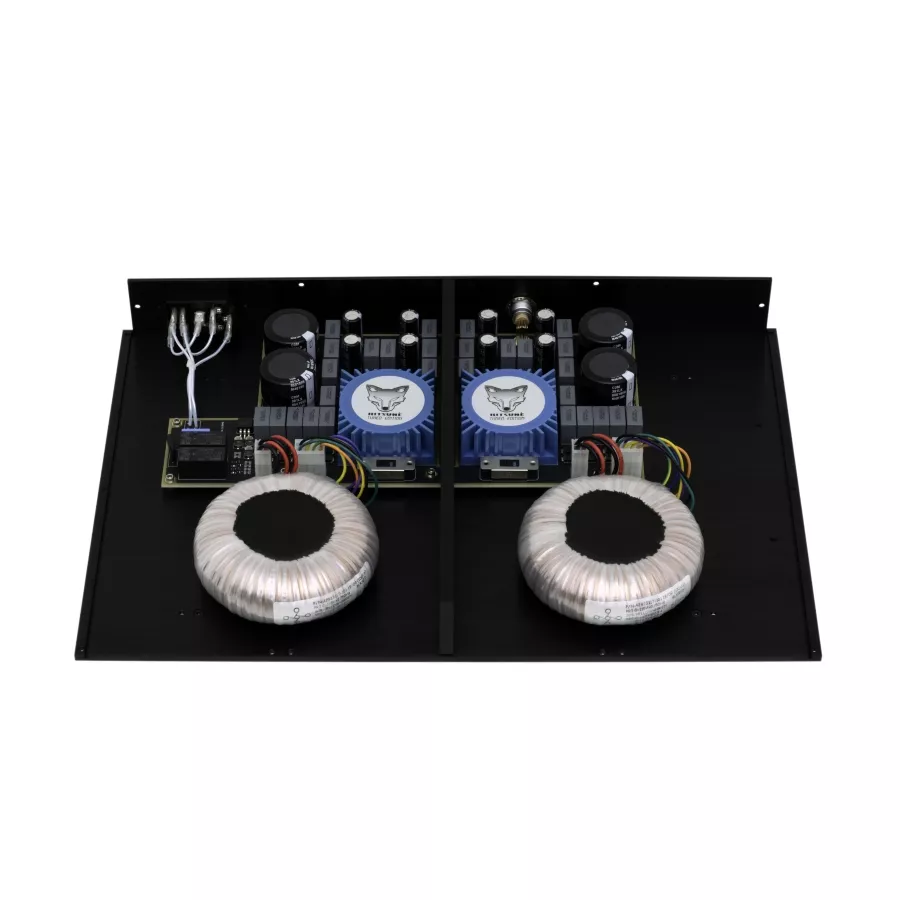
Holo Audio MAY DAC KTE – Kitsune Edition (R2R – DSD1024)
The May DAC is HoloAudio’s ultimate expression of discrete R2R design, developed over more than three years of intensive research and engineering. It is a true dual-mono DAC, with dedicated modules and custom O-type flatwire transformers powering each channel independently. This architecture achieves extraordinary dynamics, near-zero leakage, and a lifelike analog sound signature that sets a new benchmark for digital playback.
With industry-leading NOS performance, native PCM and DSD decoding, and uncompromising build quality, the May DAC represents the pinnacle of HoloAudio’s philosophy: natural, musical, and endlessly engaging sound without compromise.
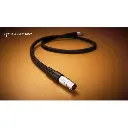
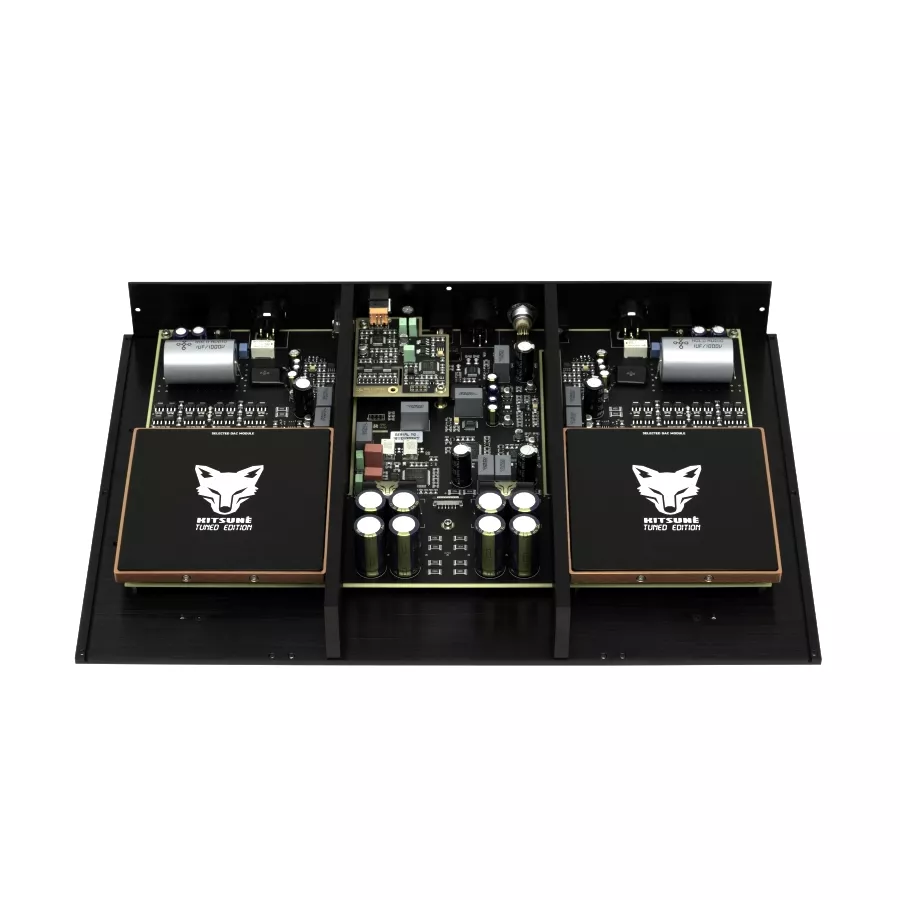
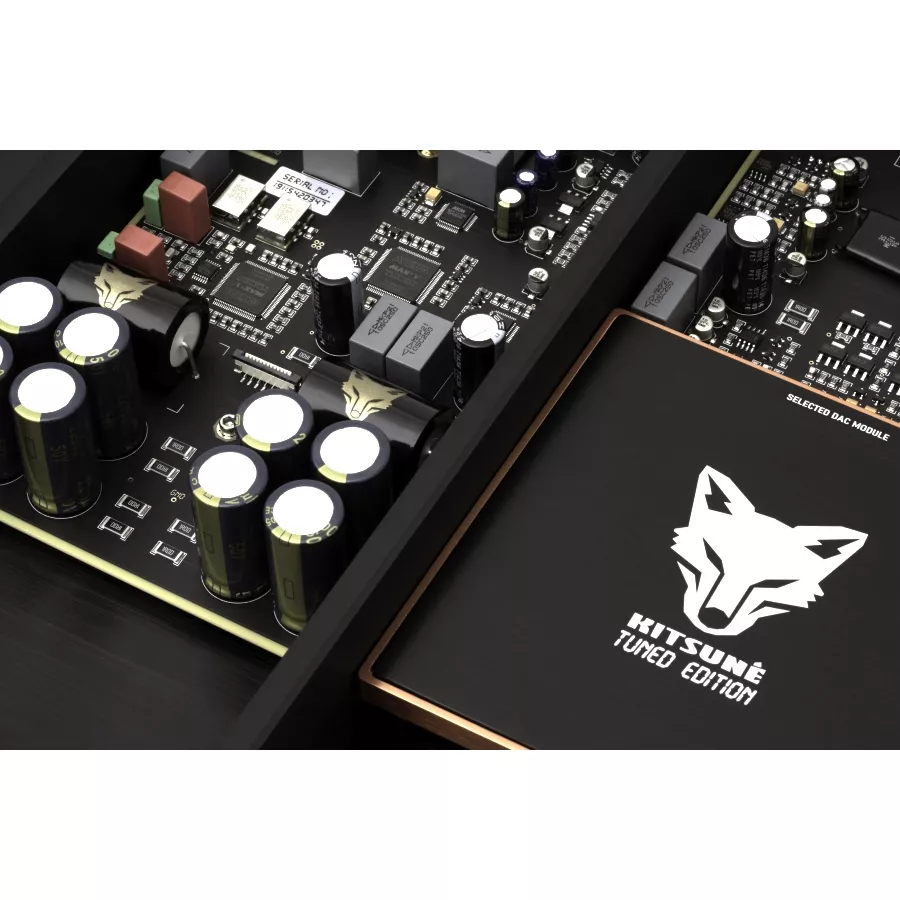
The May KTE represents the pinnacle of the lineup, tuned and crafted to achieve uncompromising performance. It features hand-selected DAC modules for the best measurements, pure OCC silver wiring, enhanced USB with Titanis 2.0, CNC shielded module covers, and custom-designed KTE capacitors unique to this edition. Every detail, from the Red Nano fuse to silver/rhodium IEC connectors, is chosen to maximize transparency and musicality.
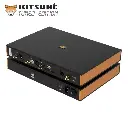
Finished with exclusive Kitsune branding, including the pure copper fox emblem, the KTE delivers breathtaking dynamics, intoxicating voicing, and reference-level sound that defines the true “endgame” DAC. For those who want nothing less than the very best, the May KTE is the ultimate choice.
| Brand: Holo Audio |
| Warranty: 5-Year Limited Warranty |
| Product Type: Digital Analogue Converters (DAC) |
Holo Audio – MAY DAC KTE – Kitsune Edition
NOTABLE FEATURES OF MAY DAC
The new generation of linear compensation technology solves the accuracy errors caused by resistor tolerance, after compensation, reaching a variance of 005% tolerance accuracy. Proprietary anti-jitter technology that provides a full amplitude of anti-jitter without increasing noise floor and other undesirable effects. Based on this new generation of technology May can provide a SINAD of >115dB and a dynamic range of >130dB, which represents the performance limit reached by todays most advanced R2R architecture DAC.
Using the ultimate performance of PLL+FIFO technology, provides 0.1Hz Third-Order low-pass ability to inhibit jitter. It also uses a high-performance femtosecond VCXO as the PLL clock source. Under the premise of being almost immune to the front-end jitter, it can also lock up to 1.5us-2us @ 1KHz signal with high jitter. (It can lock up to 1.5us-2us @ 1kHz signal with high jitter on the premise of almost being immune front-end jitter).
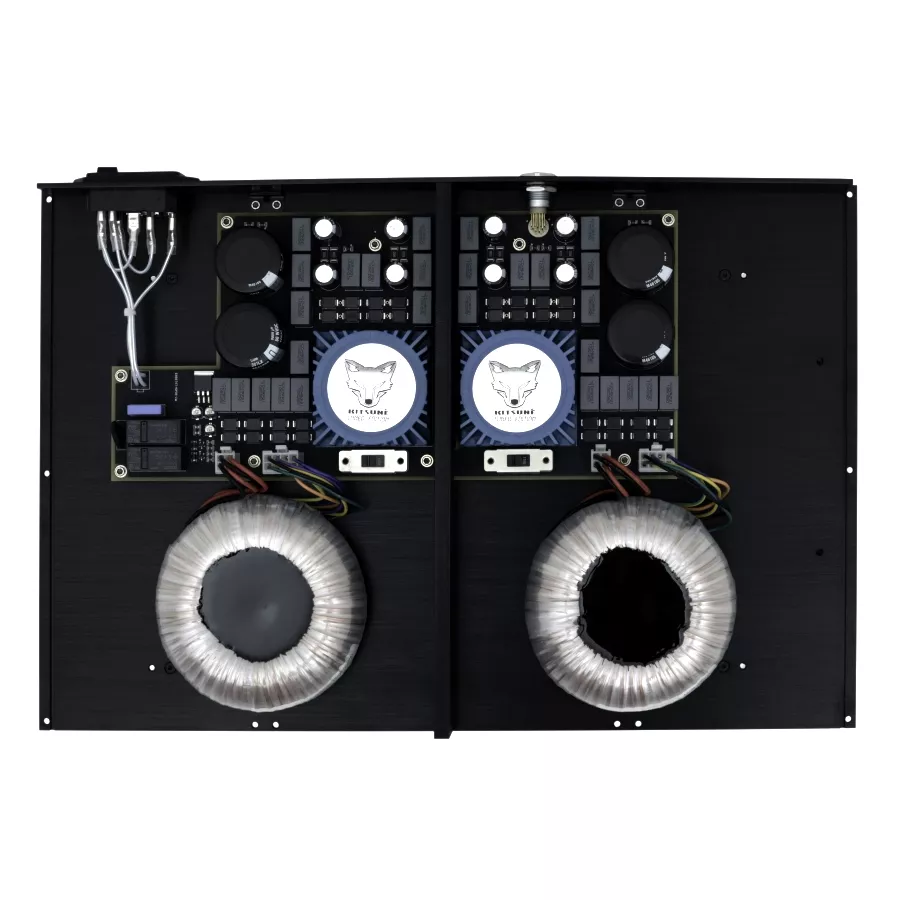
Dual Mono DAC L/R channels are independently powered by their own dedicated transformer in the PSU chassis. This provides better channel separation and more accurate sound stage.
Official Support USB and I2S up to DSD1024 and PCM1.536MHz sample rate. The USB interface uses proprietary firmware with ultra-low latency, a highly reliable data transmission, ideal USB eye pattern measurements that contributes to 2-4 times higher performance than official firmware. Two sets of independent HDMI-I2S input interfaces are provided, and each set of I2S has a four-way independent circuit, as opposed to standard LVDS chip, making I2S clock signals subject to lower interference and lower jitter. In addition, each group of I2S inputs can be configured with specific pinout configuration, making it compatible with most of the HDMI-I2S digital devices on the market.
" The KING is CROWNED! In effect, they elevated the May KTE to royalty in the DAC realm—implying it stands above virtually all competitors in its ability to convey musical realism ." Watch ful story on Youtube

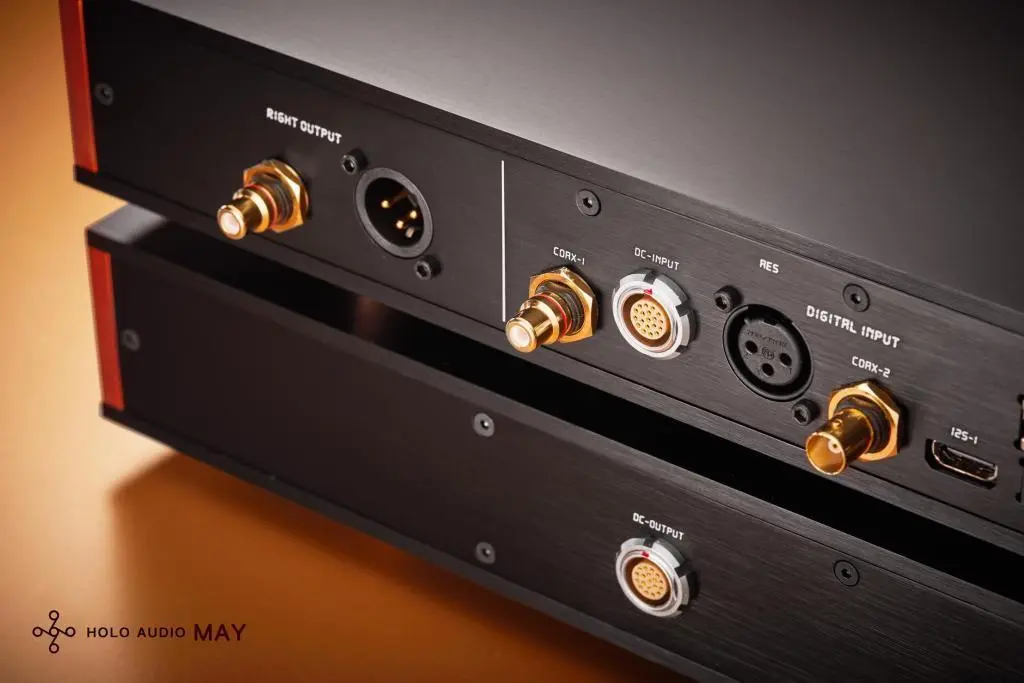
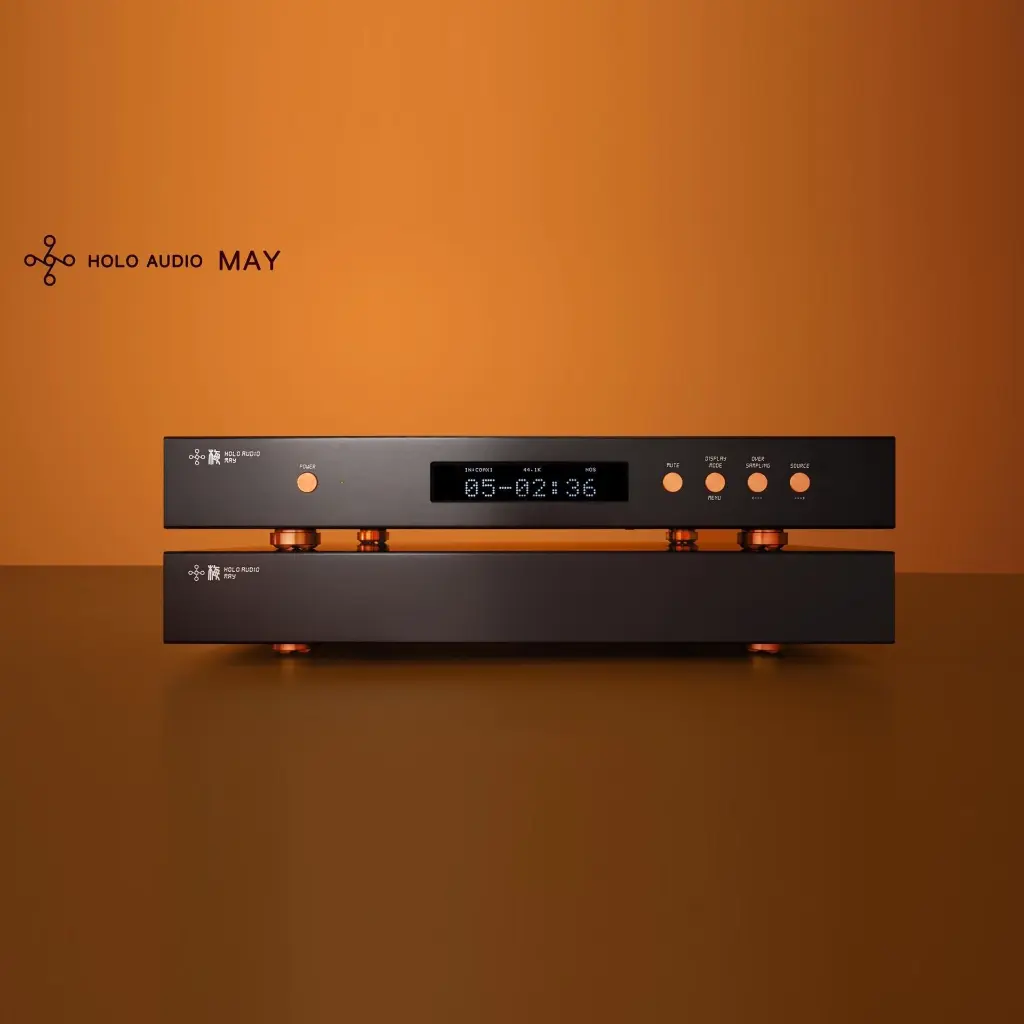
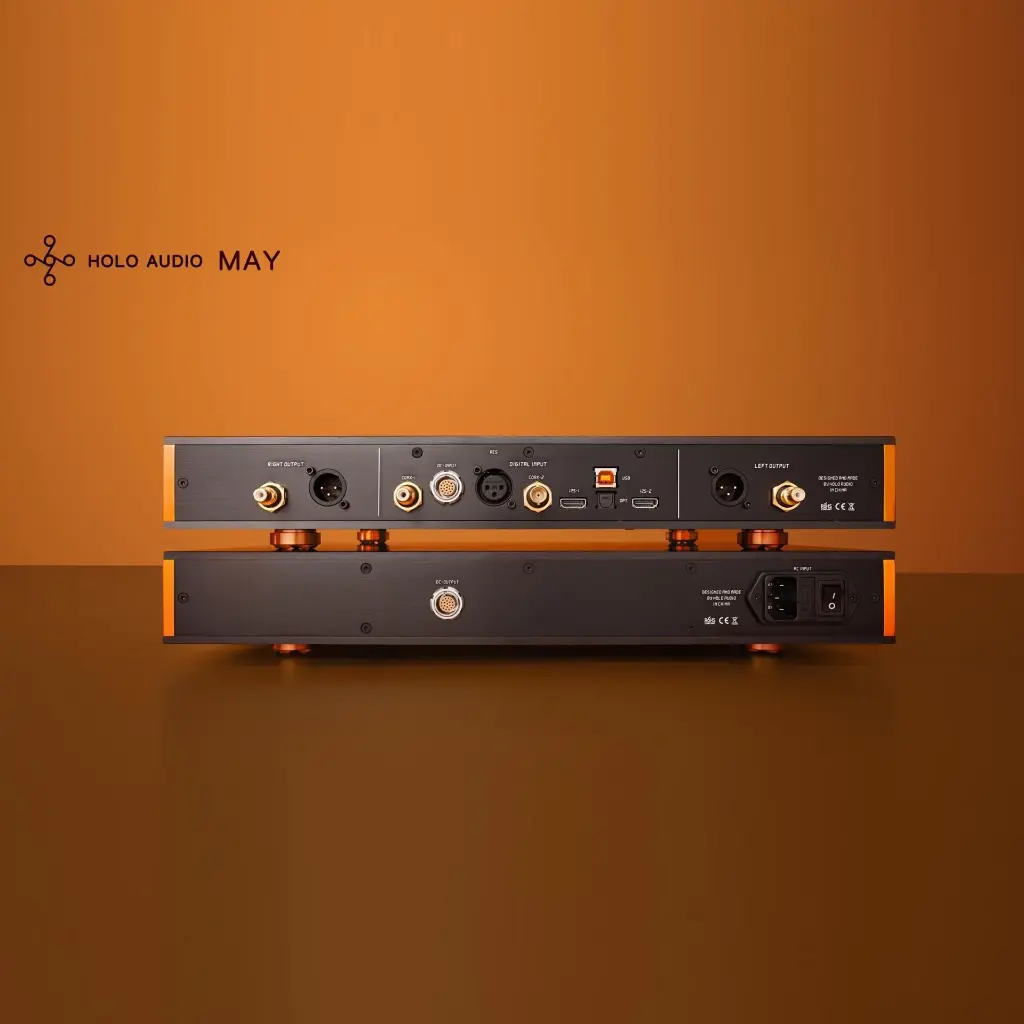
Dual-Chassis Power May DAC
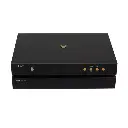
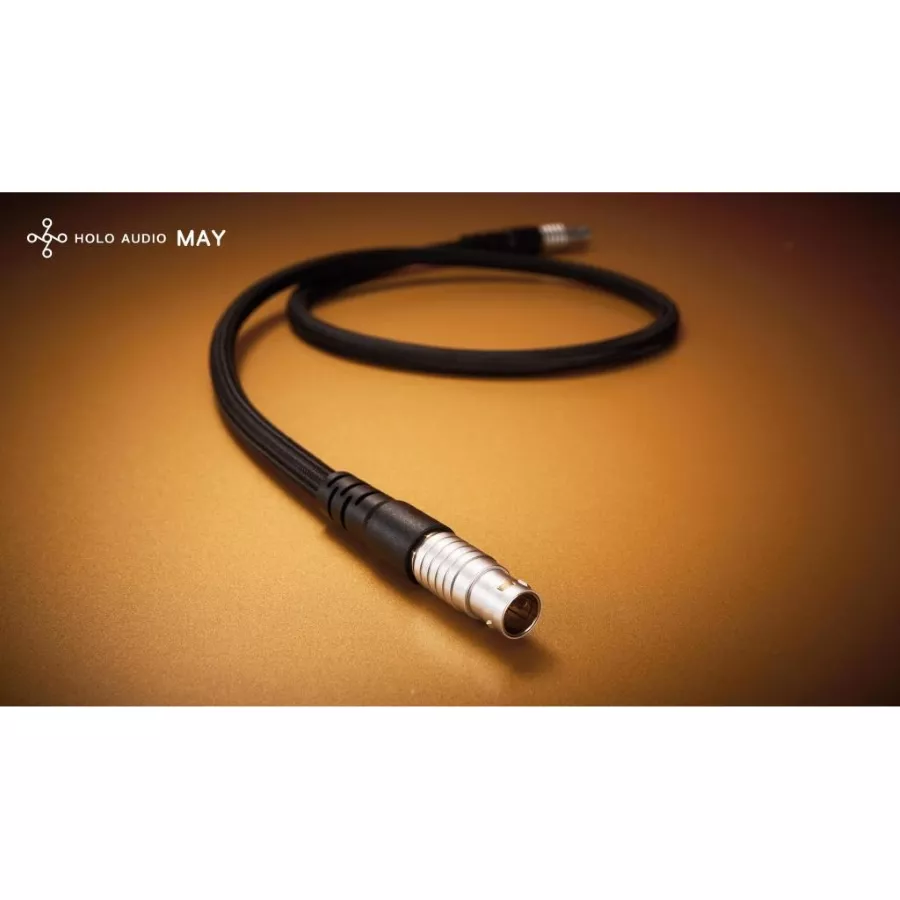
The Holo Audio May DAC takes a unique approach by separating the power supply and the DAC circuitry into two dedicated chassis. This design minimizes electrical noise and interference, ensuring that delicate digital-to-analog conversion is not compromised by power fluctuations. The two units are connected by a specially designed DC cable, which preserves signal integrity and delivers exceptionally clean power to the DAC. As a result, listeners experience a wider soundstage, improved microdetail, and a more natural musical presentation.
May DAC Details
Best design with finest components
Each channel is individually powered by it’s dedicated Otype FLATWIRE transformer found in all three models. We have found after careful testing this new transformer type outperforms ALL transformers we have ever tested to this date. Near zero leakage, improved dynamics and overall spectacular performance. They are handmade for this dac specifically and delivery world class performance you would expect.
Discrete 4 stages LVDS design
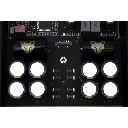
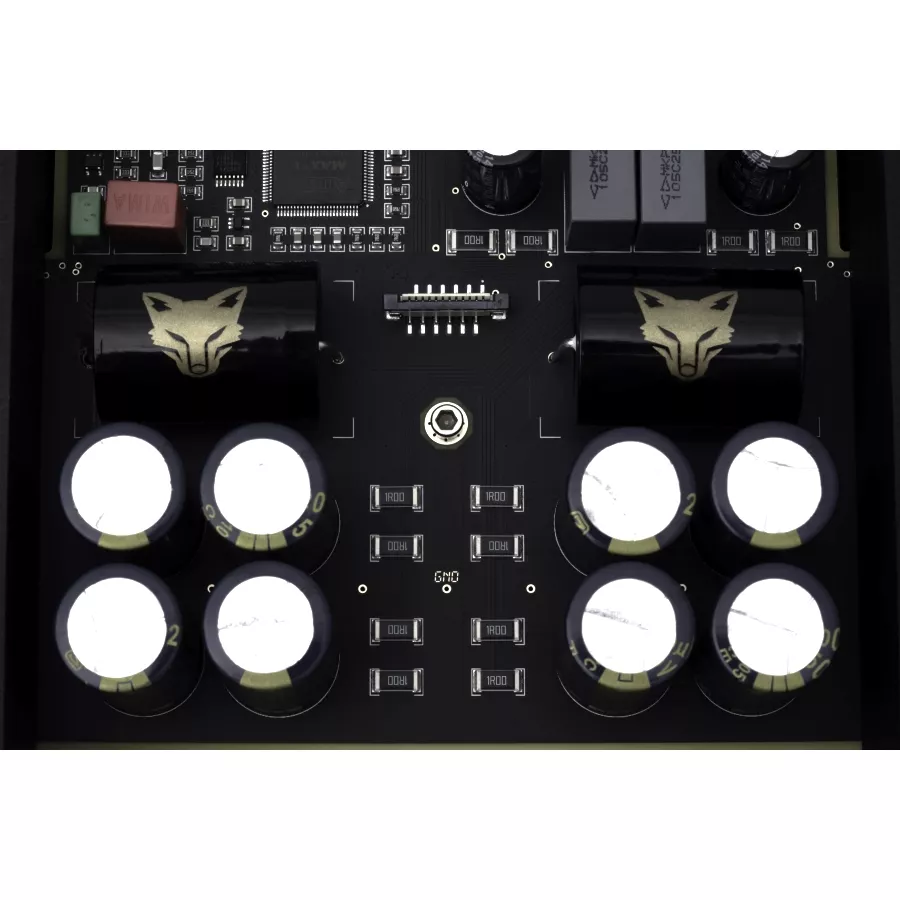
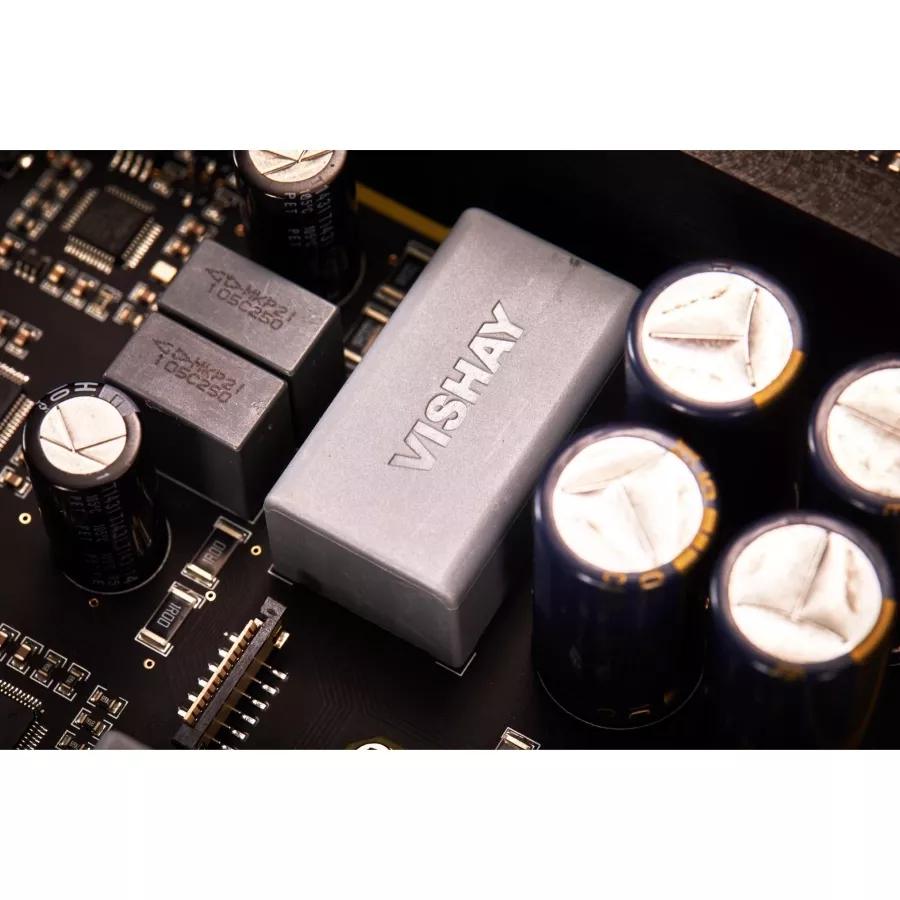
New improved power supply circuit with high performance multi stage regulation circuit using Rubycon ZLH caps, Panasonic FC, Vishay Caps or L2/KTE models with our exclusive HoloAudio Branded Caps (KTE model unique custom proprietary caps to replace Vishay caps)
May is not using a common LVDS chipset: a custom 4way circuit that isolates each line which further improves sound quality.
Softstart
The May also has a front power button. It’s been a request by many customers and gone are the days of a good old reach around to get the dac to be turned on! As mentioned before above. The dac has a soft start circuit. So don’t fret, it takes a moment for it to charge up and pull power without blowing the fuse!! It actually uses the same exact value of fuse that our spring1 and spring2 has! But two transformers! If we don’t have a soft start a couple issues can happen
one being a blown fuse from power surge, and another simply having possible pop noises. No chance of these things happening. We have carefully designed the circuit to have a zero compromise design.
USB for High-end Audio
The May DAC has the new and exclusive USB Enhanced module which has our FPGA with the new Titanis 2.0 and custom firmware to improve USB Eye Pattern and reduce latency to near zero as well as reduce jitter to very very low levels. The USB module has completely new code written to optimize performance and reduce latency significantly. Low frequency performance (-40db) is also improved. The enhanced USB module has two XMOS xu208 chips instead of one that is used in the Spring2.
There is always a limit, isn't there?
The May DAC (all three models) support DSD1024 native and PCM 1.536MHz output! Theoretically it can do DSD2048 and PCM 3.072Mhz however is untested at this time. Also, we have worked hard to reduce the common click noise with all dacs when switching from DSD to PCM. This sound click sound has been reduced significantly with a special circuit design.
HOLO Audio is the world’s first to support DSD natively on R2R DAC, so far the only one. This is not the DSD converted to PCM before digital-analog converter, but directly by the discrete components of the DSD digital to analog converter. Supported currently on MAC (DOP)and Linux (DOP), and Windows/PC (Direct Native and DOP).
There are ways to improve the performance, the segment+R2R is one way. Trimming is another way. There is an additional R2R ladder in Spring, it compensate the main R2R ladder. It works like trimming, but trimming is to change the resistor value. This additional R2R ladder are digital controlled and is to compensate the resistor tolerance. For example, the MSB of 16 bits should have the value of 32768, but due to tolerance, it represent 32700 in real world. Then that additional R2R ladder will compensate 68 into it. Then it became 32700+68=32768.
Design executed to perfection
Actually there are other ways to improve performance, I just told you two stories. There are more stories behind the design. It is really hard. I must count every via holes in layout, every PCB wire has it’s impedance and must put attention on it. A via hole can be 50 m Ohm, it is 1/20000 of 1 kilo-ohm, and you see, it covers 32768 which is the MSB of 16bits. Also the switches has self-impedance which is about several ohms to 30 ohms. If you find this issue. Maybe you will go crazy, it seems to be an impossible mission. But a good designer will overcome all these problems. It’s our value at HOLO Audio.
All the resistor tolerance, switch impedance, line impedance, via hole impedance, finally reflect as linearity. There is a chart that shows Spring’s linearity, it’s excellent. But I suggest you to look at THD performance. Bad linearity must result a bad THD performance. But good linearity doesn’t mean there will be good THD performance. THD is dynamic performance, more critical than linearity which is a static performance.
If you look at the THD performance, you will find Spring to maybe the best among those competitors. I’m applying a patent which contribute a lot of that performance. But I can’t tell you how. It’s confidential now.
Custom PLL for Ultra-Low Jitter Performance
The Holo Audio May DAC features a highly advanced, fully custom PLL (phase-locked loop) circuit designed for ultra-low jitter performance. Even the highest levels of jitter are effectively eliminated, delivering world-class sound quality. At the heart of this system are Crystek VXCO clocks, which reclock any incoming digital signal with extreme precision. This feature can be enabled or disabled to demonstrate its exceptional performance. Unlike off-the-shelf PLL solutions, May’s PLL is, to our knowledge, the most powerful ever implemented in a DAC.
Why SPDIF and Toslink Introduce Jitter
SPDIF, a protocol developed in the 1970s for CDs by Sony and Philips, encodes data and clock signals together, allowing transmission over a single cable. While convenient, this encoding process introduces jitter, and Toslink, the fiber-optic version of SPDIF, adds further timing errors during electronic-to-optical and optical-to-electronic conversion. By contrast, I2S separates the signals—three clocks and one data line—avoiding encoding-related jitter entirely, making it a superior interface for high-performance playback.
To mitigate jitter from SPDIF, a PLL uses a local clock to track the source signal and smooth timing deviations. For example, if the source alternates between 44,101 Hz and 43,999 Hz, a weak PLL might only partially correct it, while May’s high-performance PLL locks the clock to within micro-Hz of the ideal 44,100 Hz. Standard SPDIF chips, like the AK4118A, achieve around 50 ps jitter, which is excellent for commercial chips but far from the HiFi standard May aims for. Achieving stronger PLL performance is extremely challenging, requiring a precise local clock that can adjust to the source in real-time.
FIFO Buffering: Preserving Every Sample
Instead of using a common VCO, May employs a VCXO (Voltage-Controlled Crystal Oscillator)—specifically Crystek’s CVHD-957—providing unmatched stability and precision. Synchronizing the data with this clock is equally critical: incoming samples fluctuate due to source jitter, and a simple digital filter like an ASRC would modify the data, compromising bit-perfect accuracy. May solves this with a sophisticated FIFO buffer system, storing extra samples during high-frequency jitter periods and releasing them during low periods, preserving every bit of data perfectly.
Unmatched Long-Term Stability and Jitter Reduction
The result is a PLL with a corner frequency of 0.05–0.1 Hz across three orders, capable of reducing long-term jitter by 90%, 1-second jitter by 99%, and 0.1-second jitter by 99.9%. Unlike many industrial PLLs that unlock under extreme jitter, May’s system maintains a stable lock, ensuring uninterrupted, distortion-free playback even in the most challenging conditions. This combination of precision clocking and intelligent data handling makes May’s PLL one of the most powerful and effective ever designed for a DAC.
Why True Channel Separation Matters for Pure, Distortion-Free Sound
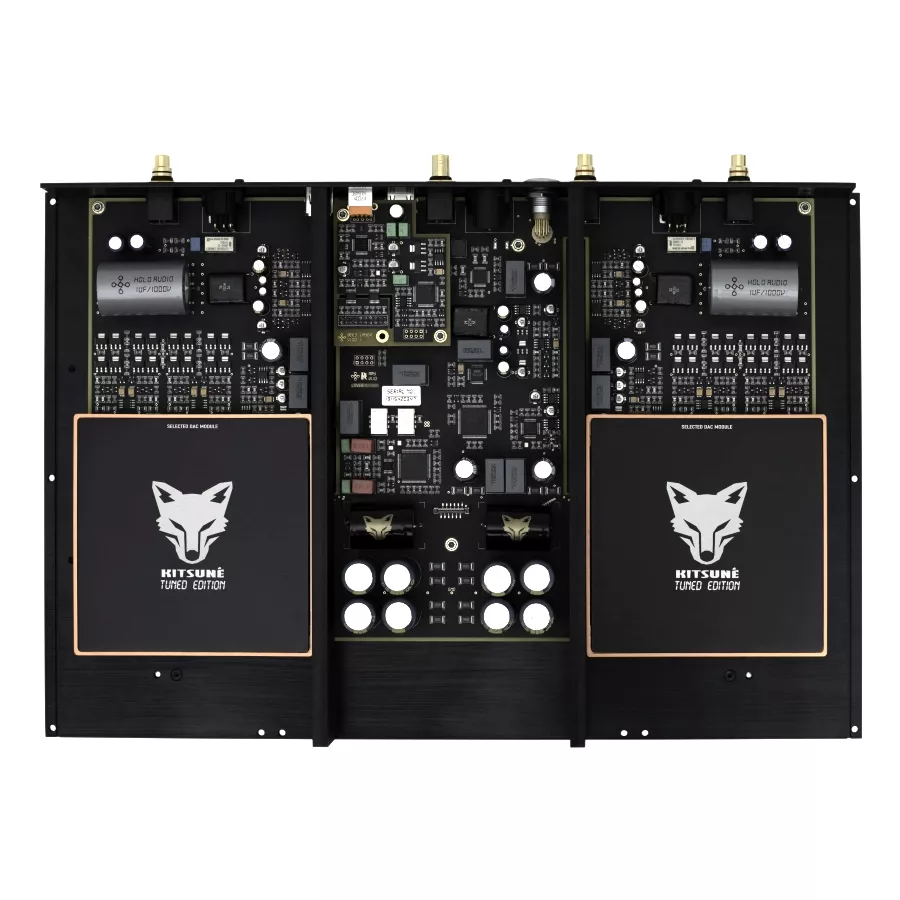
The May is a DUAL mono DAC. so there is a dedicated Dac Module for Left Channel and a dedicated Dac Module for Right Channel.
The principle of completely separating the left and right channels is to prevent any form of interference from reaching the audio circuits. The term “crosstalk” only partially describes the issue and doesn’t capture the full picture. Since music is inherently built on left/right spatial information, a very low crosstalk measurement—often obtained with simple sine waves—doesn’t necessarily reflect real-world performance. In actual music playback, powerful and dynamic signal peaks occur, requiring each output stage to draw substantial current independently. At those moments, it is critical that there is no interaction through a shared power supply or ground path carrying signal current. Only under these conditions can an amplifier deliver a completely clean and distortion-free reproduction.
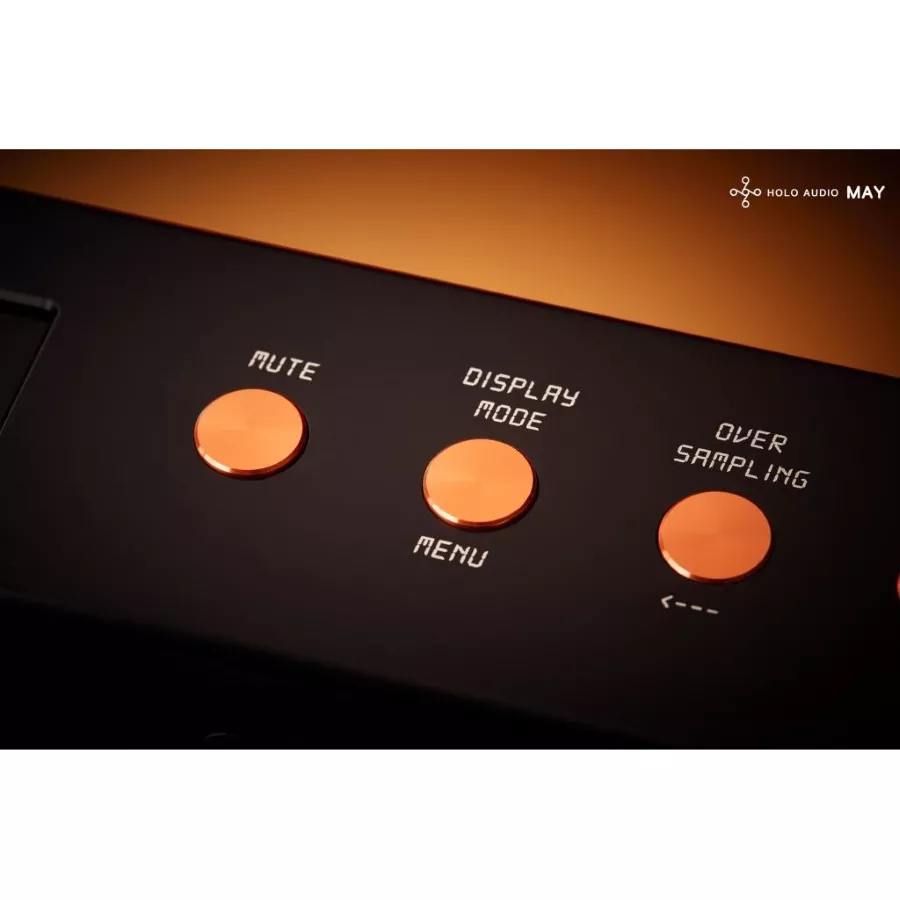
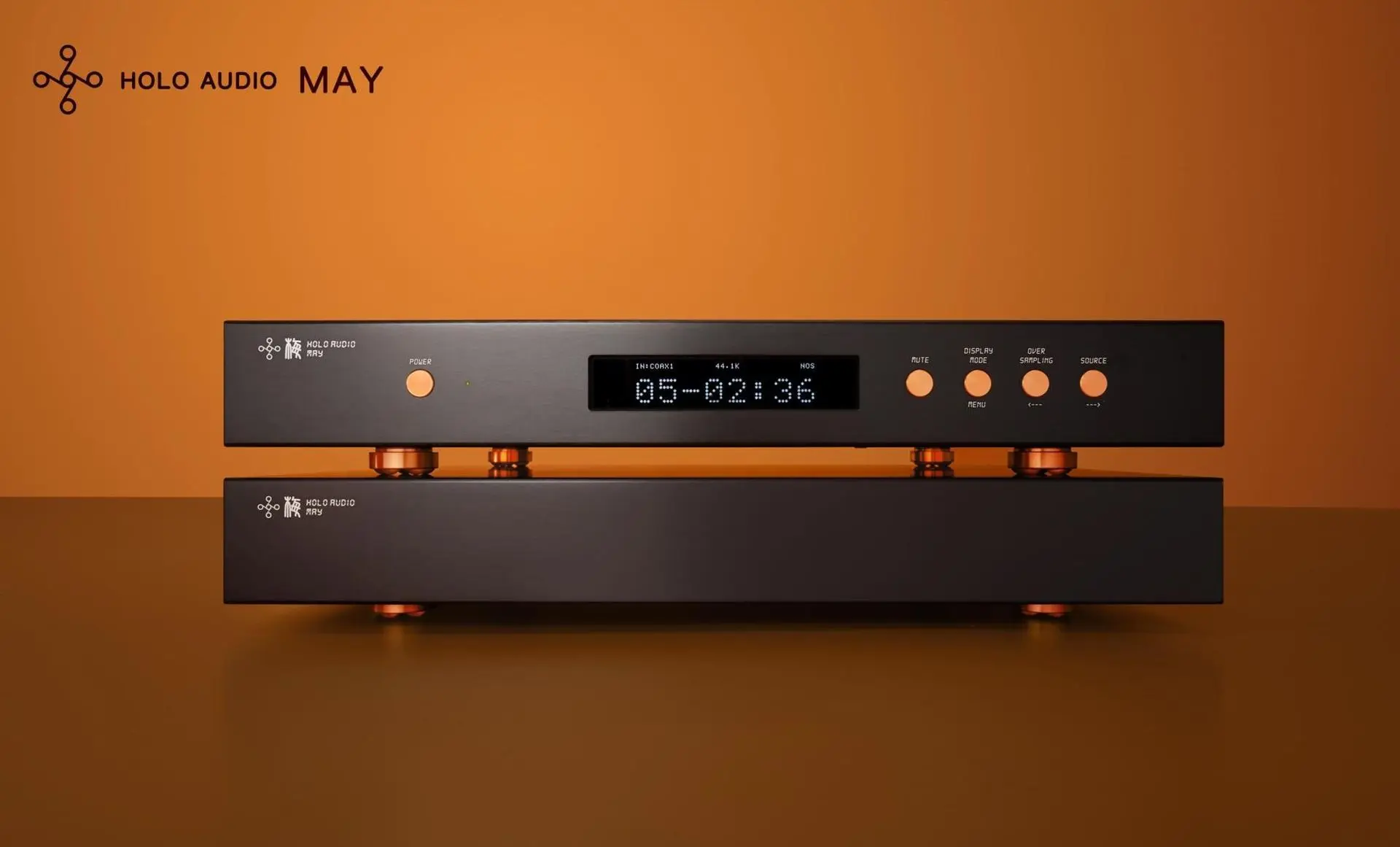
May dac also has an improved display on the front that appears the same as the Spring2 on initial glance . Font size is bigger than Spring2 but smaller than Spring1. Also you can see the CD track-time information is displayed when using spdif inputs!. This is done by extracting additional data from SPDIF. This a part of CD red book standard but nobody notices this and often forgets this cool feature or doesn’t know how to extract the data!. This will lead a fashion for other DAC developer to support this feature customers will surely love this feature albeit subtle. The screen is much better contrast and viewing angles and one of the first things one may notice.
Flexible NOS and Oversampling Modes for Ultimate Sound Fidelity
NOS mode, without oversampling, the original data directly to the analog conversion. NOS can avoid these problems because digital oversampling can produce time-domain distortions such as ringing effects. NOS will usually have a significant impact on other performance indicators, but the spring design can make the NOS mode also maintain a good performance indicators.
OS mode, make PCM oversampling to reach a higher frequency PCM, the DSD oversampling to a higher frequency DSD, and then digital analog conversion. OS PCM mode, whether it is PCM input or DSD input, will be oversampled to PCM mode for digital analog conversion
OS DSD mode, whether PCM input or DSD input, will be oversampled to DSD mode for digital analog conversion.
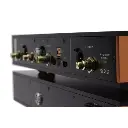
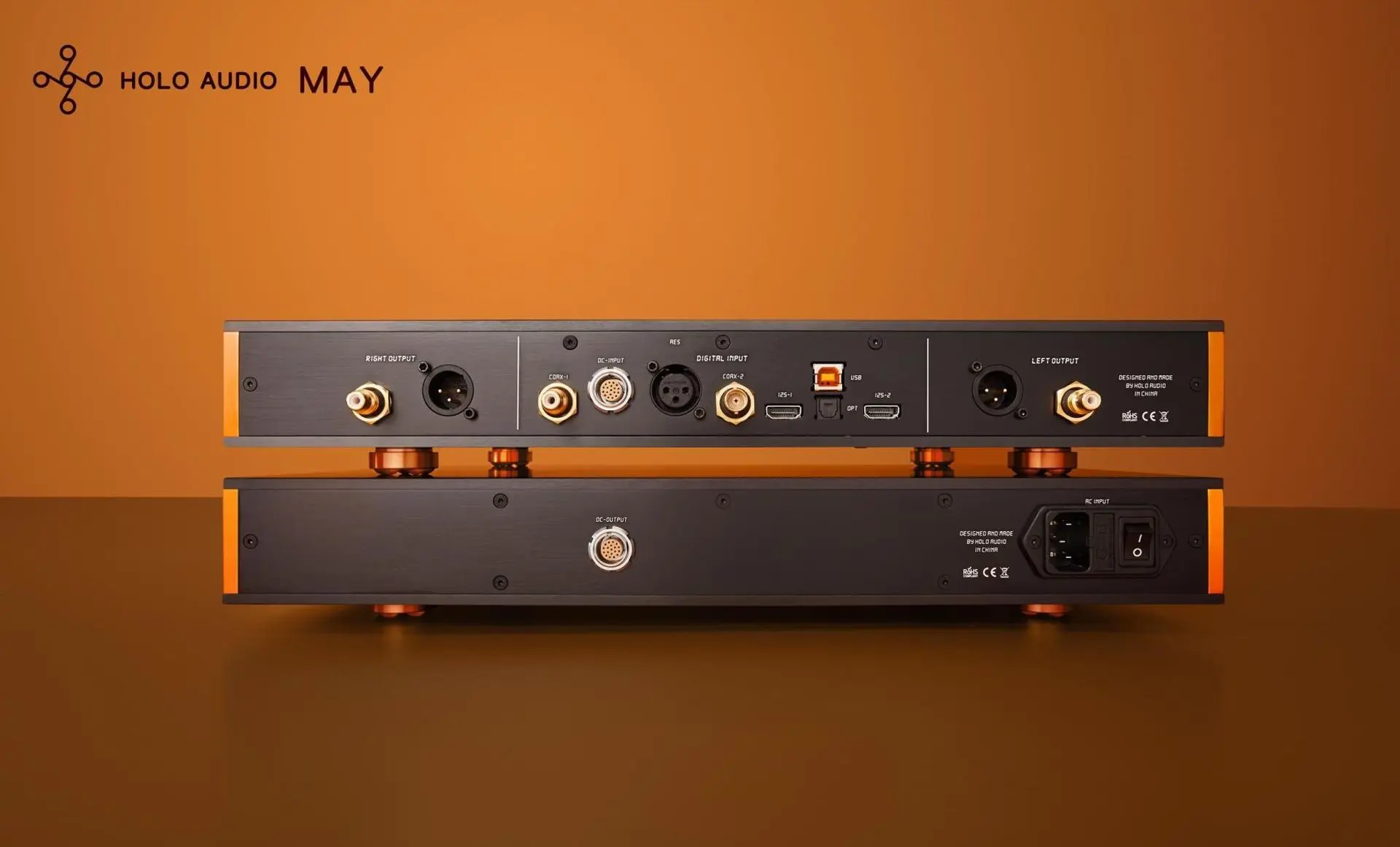
Digital input interface, including, USB (ground isolation), RCA, BNC, AES, optical fiber, HDMI interface, I2S. All digital input interfaces support DSD (DOP mode). Spring analog output interface for the single-ended and balanced each group.
Why the May DAC Deliberately Leaves Out Volume Control for Purest Sound
In the Holo Audio May DAC, the absence of a built-in volume control is a deliberate design choice aimed at preserving the purest possible signal quality. A true preamplifier is responsible for critical tasks such as providing additional gain, lowering output impedance, and handling balanced or unbalanced signal conversion. Without these functions, a simple digital or analog volume control inside a DAC can create mismatches between components, leading to a weaker signal and compromised sound quality. By leaving volume control to a dedicated preamp, the May DAC ensures that its analog output remains completely uncompromised, delivering music with the highest possible fidelity.
USB IMPLEMENTATION: A STEP BEYOND
Enhanced Titanis USB input
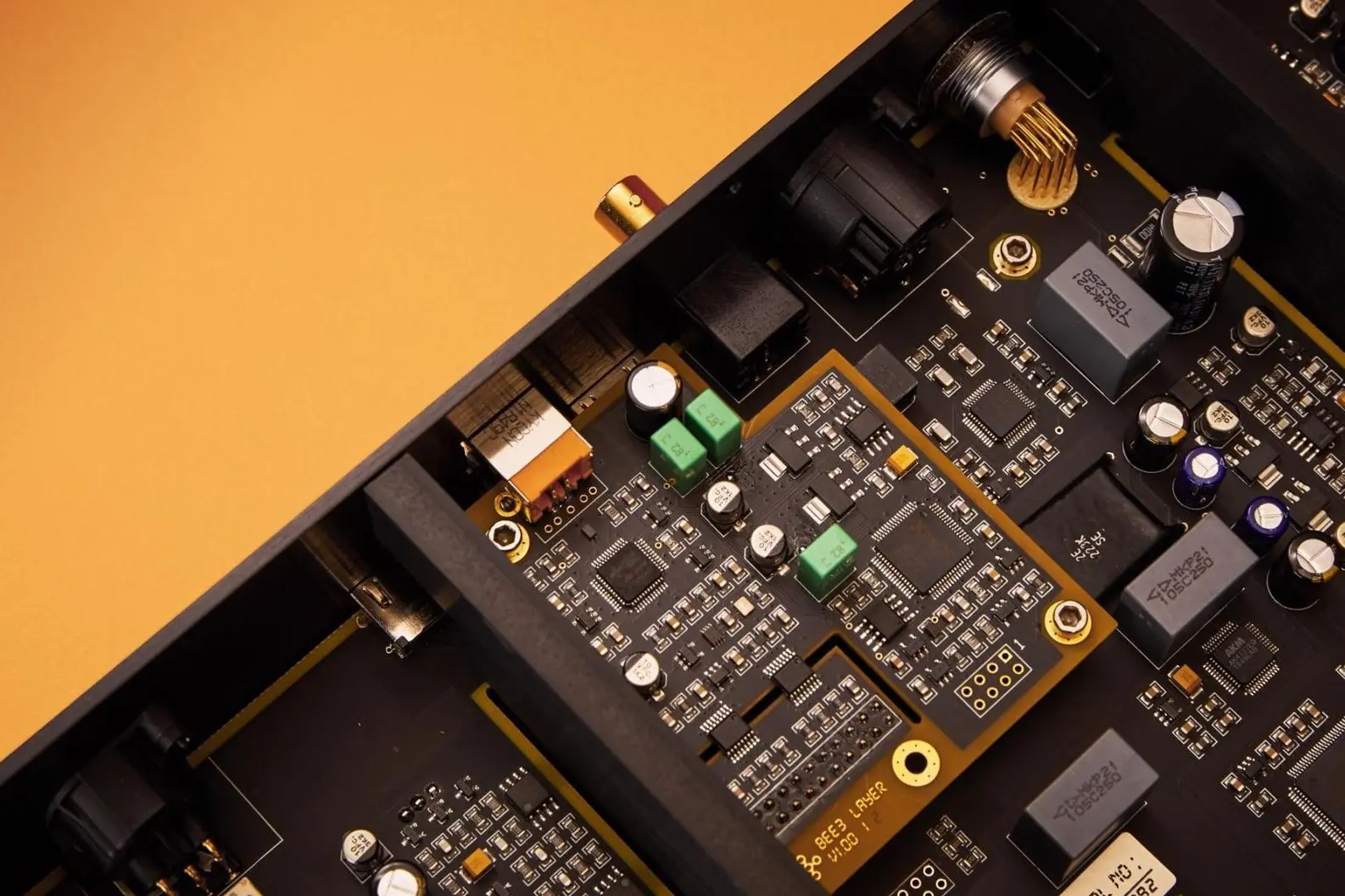
- The May DAC’s enhanced USB Titanis input, featuring a dual XMOS design, delivers exceptionally clean and precise digital signal handling. This advanced architecture minimizes jitter and maximizes resolution, ensuring every nuance of the music is faithfully reproduced.
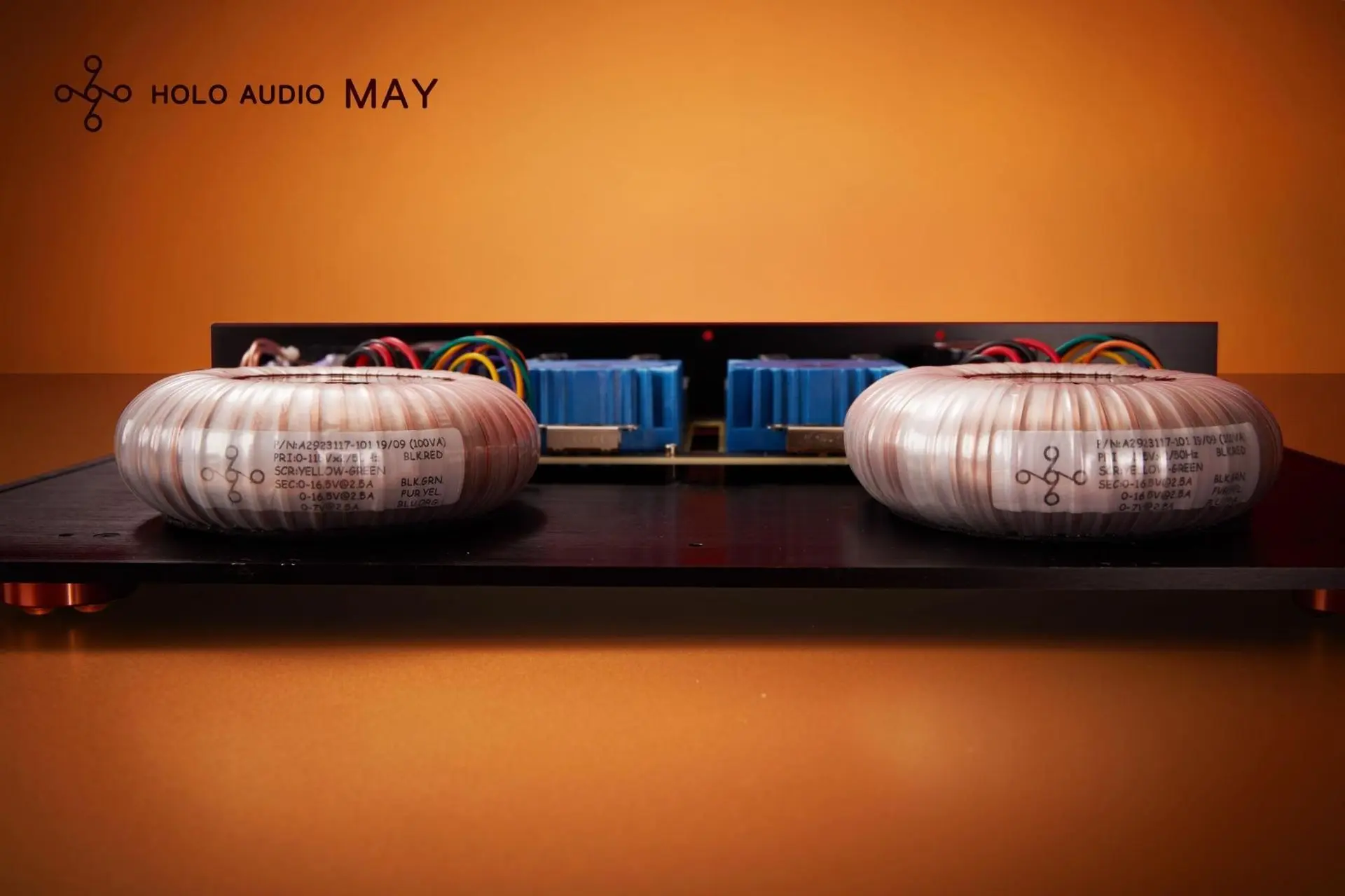
INDEPENDENT POWER SOURCE
O-type FLATWIRE transformerS
The May DAC’s dual-mono design features a dedicated DAC module and a dedicated O-type FLATWIRE transformer for each channel, ensuring completely independent power delivery. These handcrafted transformers offer near-zero leakage, enhanced dynamics, and truly world-class performance, surpassing every transformer we have ever tested.
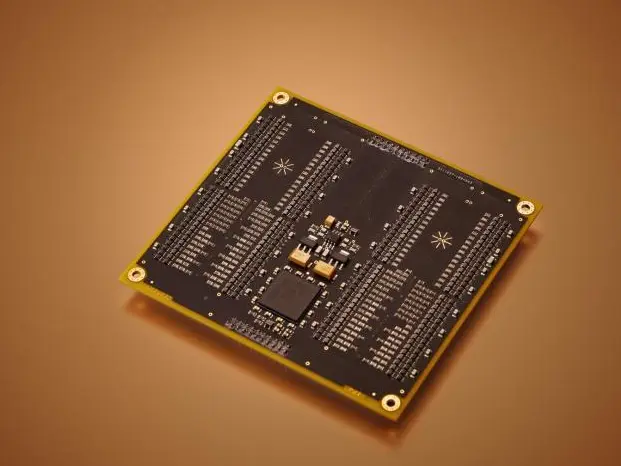
R2R DIGITAL ANALOGUE CONVERSION
Dual R-2R ladder: pure, independent channels
The May DAC takes R-2R conversion to the next level, with a dedicated ladder for each channel for pure, independent signal paths. This eliminates crosstalk and keeps every note perfectly positioned in the stereo field. The result is breathtaking clarity, dynamic realism, and a truly lifelike musical experience.
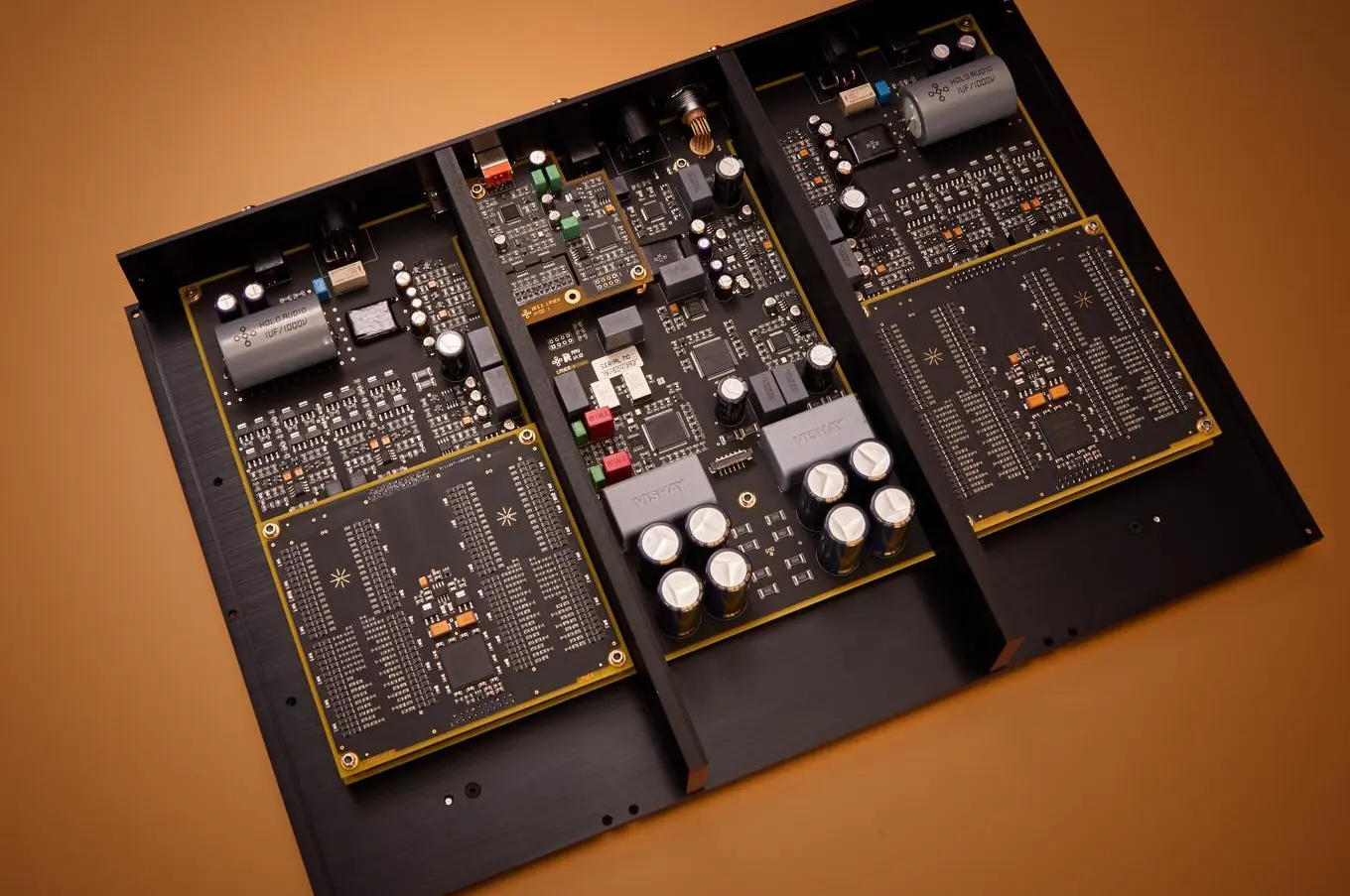
MAY DAC - PRECISION PERFECTED
Precision Perfected: Every Detail Thoughtfully Crafted
The May DAC is a triumph of precision engineering, where every detail has been carefully considered. Its design reflects meticulous attention to every element, leaving nothing to chance. The result is a flawlessly executed system that delivers uncompromising performance.
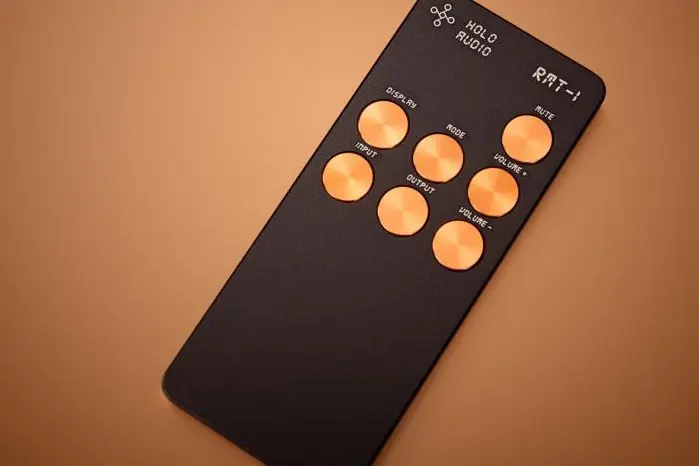
MAY DAC - REMOTE CONTROL
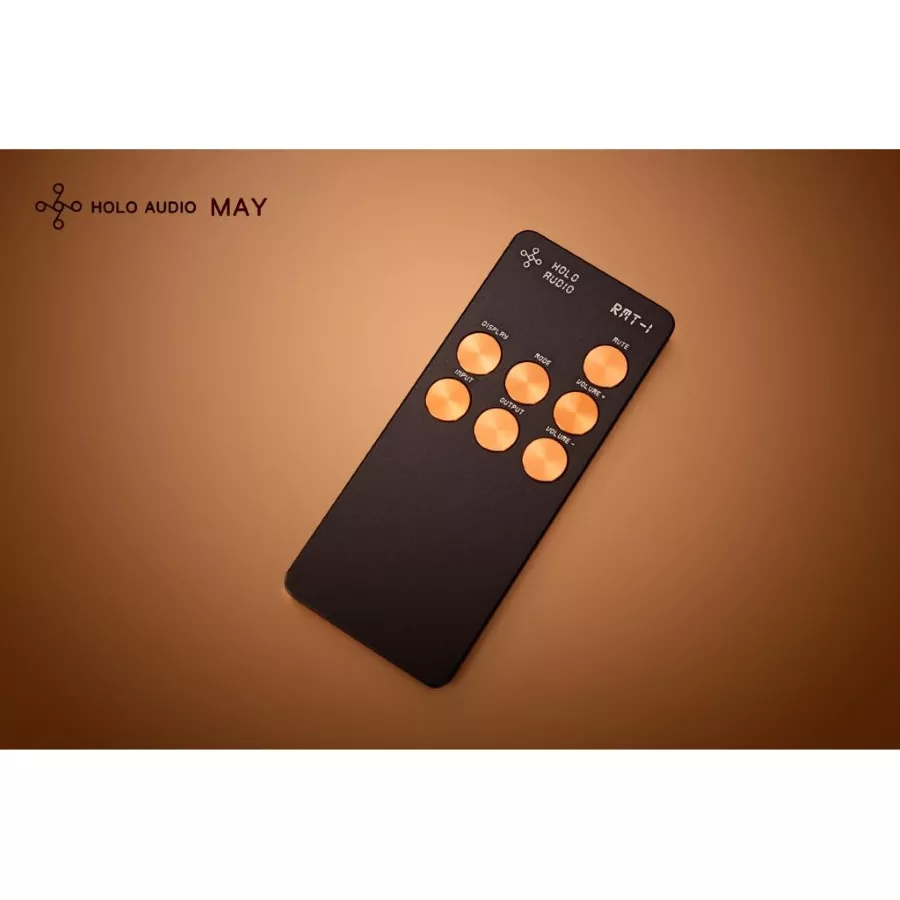
CNC machined aluminum remote control
The May DAC features a precision CNC-machined aluminum remote control, combining durability with a sleek, high-end finish. When purchasing the May DAC together with either the Serene or Bliss, a special remote is included that can seamlessly control both devices. This thoughtful design ensures convenience without compromising the luxurious feel and build quality.
TECHNICAL SPECIFICATIONS
DIGITAL INPUTS | |
| COAXIAL1, COAXIAL2, OPTICAL, AES | PCM 44.1-192K (24bit) DSD 64X (DOP) |
| USB | PCM 44.1K-1.536M (32bit) DSD 64-512X (DOP) DSD 64-1024X (Native) |
| I2S1,I2S2 | PCM 44.1K-1.536M (32bit) DSD 64-1024X |
ANALOGUE OUTPUTS | |
| PCM 48K NOS | THD+N 0.00017% @1K(-115dB) DNR 130dBRCA: Voltage Output 2.9Vrms and Imp 27 Ohm XLR: Voltage Output 5.8Vrms and 54 Ohm |
| DSD 128X | THD+N 0.00025% @1K(-112dB) DNR 115dBRCA: Voltage Output 1.45Vrms and Imp 27 Ohm XLR: Voltage Output 2.9Vrms and 54 Ohm |
PHYSICAL CHARACTERISTICS | |
| Size (Main Box) | 430x300x55mm (W x L x H, Dimensions do not include protruding parts) |
| Size (Power Chassis) | 430x300x55mm (W x L x H, Dimensions do not include protruding parts) |
| Weight | 18kg/39.68lbs |
CONFIGURATION | |
| Power Input (configurable) | 220-230V 50/60Hz – Fuse Type 2A SB 5x20mm 110-115V 50/60Hz – Fuse Type 4A SB 5x20mm |
| Power consumption | 60W |
KTE (KITSUNE EDITION) MAY DAC
- Titanis enhanced usb GEN 2.1 module
- Upgraded Fuse
- 100VA DUAL O-type(not Toroid) FLATWIRE (NOT roundwire) 6N Copper custom hand made audio transformers. (All models)
- All copper wire is replaced with 1.5mm pure occ silver wire. Only KTE model
- Hand Selected Dac modules to have best measurements compared to averages. Higher dynamic range. Only KTE model.
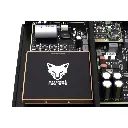
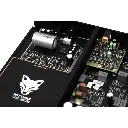
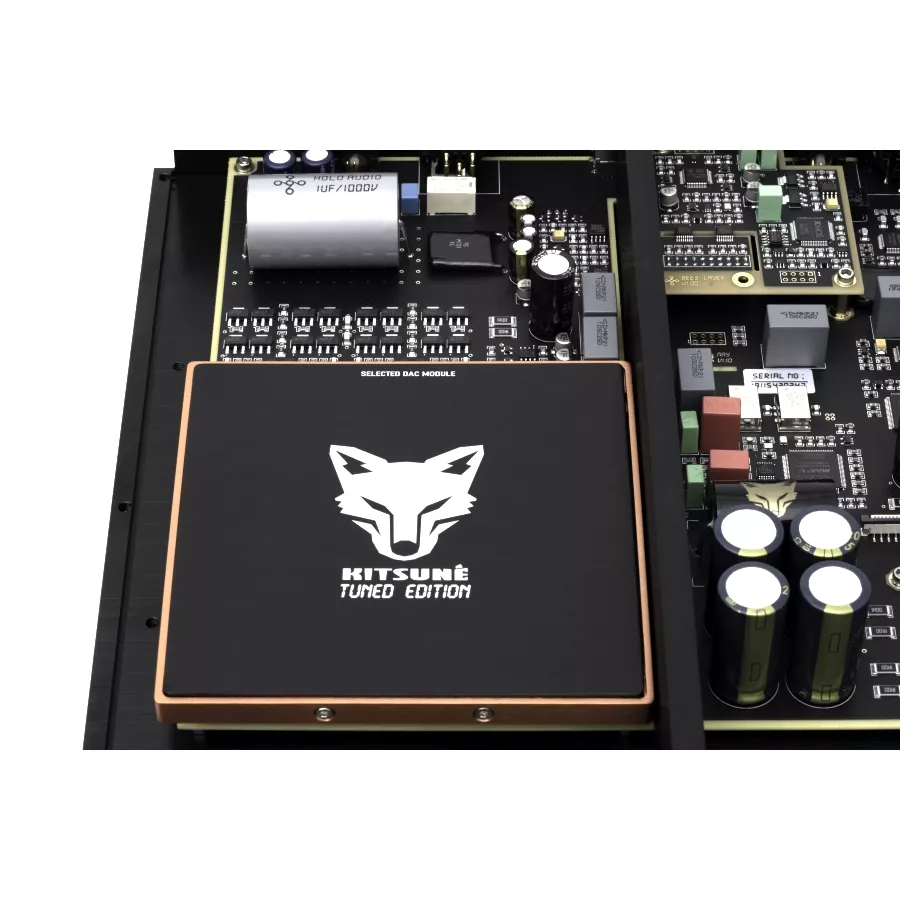
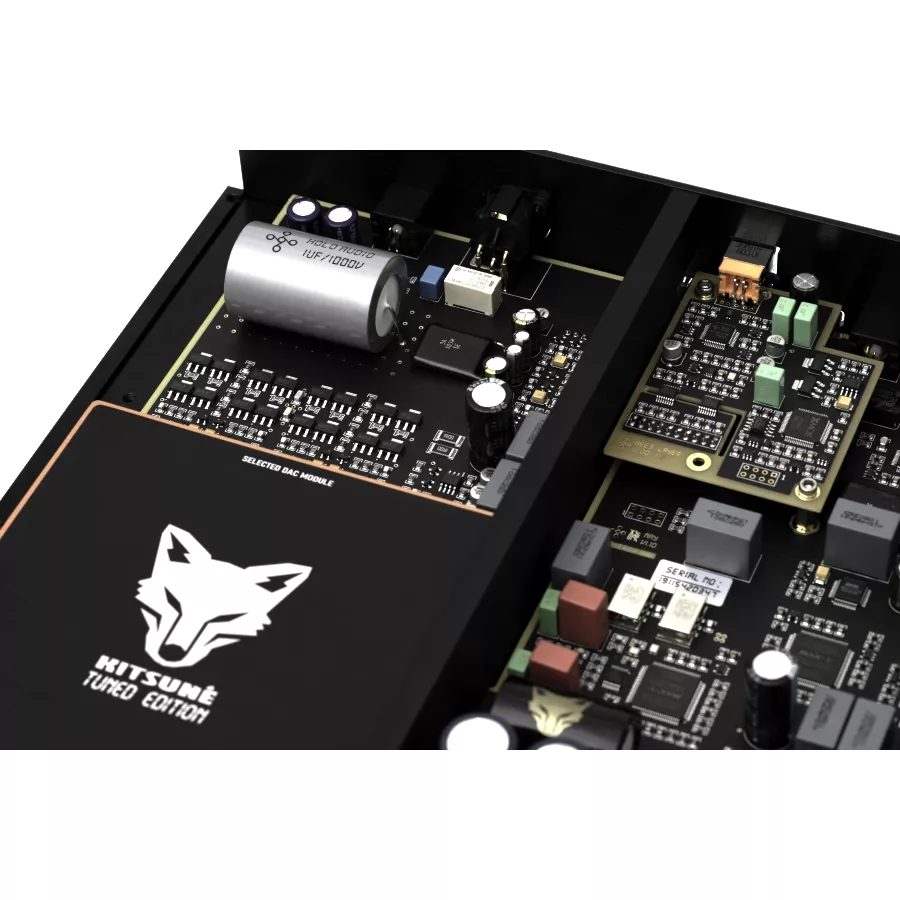
- CNC Black/Copper shield DAC Module Covers on each module with laser etched KTE logos. Only KTE model.
- Replaced IEC inlet connectors with pure silver/rhodium plated faston connectors at the IEC inlet Only KTE model.
- Fuse is upgraded with world class Red Nano fuse with gold/silver and graphene and quartz filtering materials. Only KTE Model
- Standard Vishay caps are replaced/upgraded with KTE capacitors***
- Custom made HoloAudio 1000V 1uF caps (replaces standard mundorf evo silver/gold caps)
- Enhanced USB module with Titanis 2.0 circuit
- Special Kitsune Tuned Edition branding inside and out (pure copper Kitsune fox emblem on top panel) + remote control
***unique ONLY to MAY KTE – KTE Caps to replace Vishay on the L1/L2 models (we have done extensive testing and these prove to provide intoxicating voicing and are beyond subtle improvements over L1/L2)
Story
Why the May DAC?
The story of the Holo Audio May DAC begins with a simple but ambitious idea: to create a digital-to-analog converter that could capture music with absolute fidelity, exactly as the artist intended. Holo Audio’s founder, Jeff Zhu, recognized that even the best DACs were limited by compromises—crosstalk, jitter, and the weaknesses of shared power supplies all subtly distorted the sound. He envisioned a system where every component, from the R-2R ladder to the transformers and clocks, worked in perfect harmony, with no shortcuts. The May was born as a dual-mono masterpiece, with each channel independently powered and clocked, a carefully engineered architecture that eliminates interference, preserves every nuance, and delivers a musical experience that feels alive and breathtakingly real.
That’s why May DAC
That’s why the May DAC was designed: to push digital-to-analog conversion to its absolute limits and deliver music exactly as it was meant to be heard. From the very beginning, the goal was to eliminate every compromise that could color or distort the sound—whether it was crosstalk between channels, jitter in the digital signal, or limitations from shared power supplies. Each channel has its own dedicated R-2R ladder, transformer, and power circuitry, ensuring complete independence and purity of signal. Advanced clocking with custom VCXO and intelligent FIFO buffering keeps even the smallest timing deviations under control, preserving every micro-detail. Every design choice, every component, and every connection was meticulously considered, resulting in a system that combines technical perfection with musicality. In the end, the May DAC isn’t just a device—it’s a vessel that delivers the emotion, depth, and realism of the original recording with breathtaking clarity.
Holo Audio May KTE - Reviews & Awards

Holo Audio
When people talk about innovation in high-end audio, the name Holo Audio often comes up. Behind the brand stands Jeff Zhu, a designer whose vision has helped redefine what digital-to-analog conversion can be.
Jeff Zhu’s journey into audio began with a passion for music and engineering. While many manufacturers follow wellworn paths in digital audio design, Jeff believed there was room for something more radicaln approach that combined cutting-edge engineering with the natural warmth and presence music lovers crave.
That philosophy led to the creation of Holo Audio, a company that quickly gained worldwide recognition. The Spring DAC and May DAC series put Holo Audio firmly on the map, introducing the world to discrete R2R DAC designs and groundbreaking technologies such as true linear compensation. These innovations solved long-standing problems in digital playback, allowing Holo Audio products to reproduce music with remarkable accuracy, texture, and emotional impact.
But beyond the technical achievements, Jeff Zhu’s work reflects a deeper philosophy: audio gear should serve the music, not the other way around. Every Holo Audio product is built with this principle in mind, balancing advanced engineering with a focus on musicality, craftsmanship, and longevity.
Today, Holo Audio continues to expand its reputation across the globe. With Jeff Zhu at the helm, the company remains committed to pushing the boundaries of what’s possible in digital audio, while staying true to the simple goal that started it all: helping people connect more deeply with the music they love.
Tim Connor has many years of experience in the Audio Industry and is passionate about just enjoying the music. He strives to exceed your expectations by helping you choose the right products that fit best for your needs. Please contact him with any questions you may have. His wife, Dawn Connor, is also very passionate about music, and sang in Choir for many years. She enjoys learning about and working on electronics, (including past experience with guitar equipment) audio grade, and higher specification, wiring and the founder of KitsuneHifi.
In the world of audio equipment, wires are the staple of life as they are required to transfer electricity, the more strands the better conductivity and electricity transferred more efficiently. As with a wise kitsuné, the more skilled and knowledgeable the craftsman the better the end result.
At KitsunéHiFi we’re always searching for the mythical creature… the awe inspiring equipment of legends.
The kitsuné logo was inspired by a few things, a bedside lamp with a cute little fox, the fox-spirit from Never Alone (Kisima Ingitchuna) (which Dawn kept calling a kitsuné), and our pup which looks a lot like a little fox and credited in part to the Kitsuné head logo
